





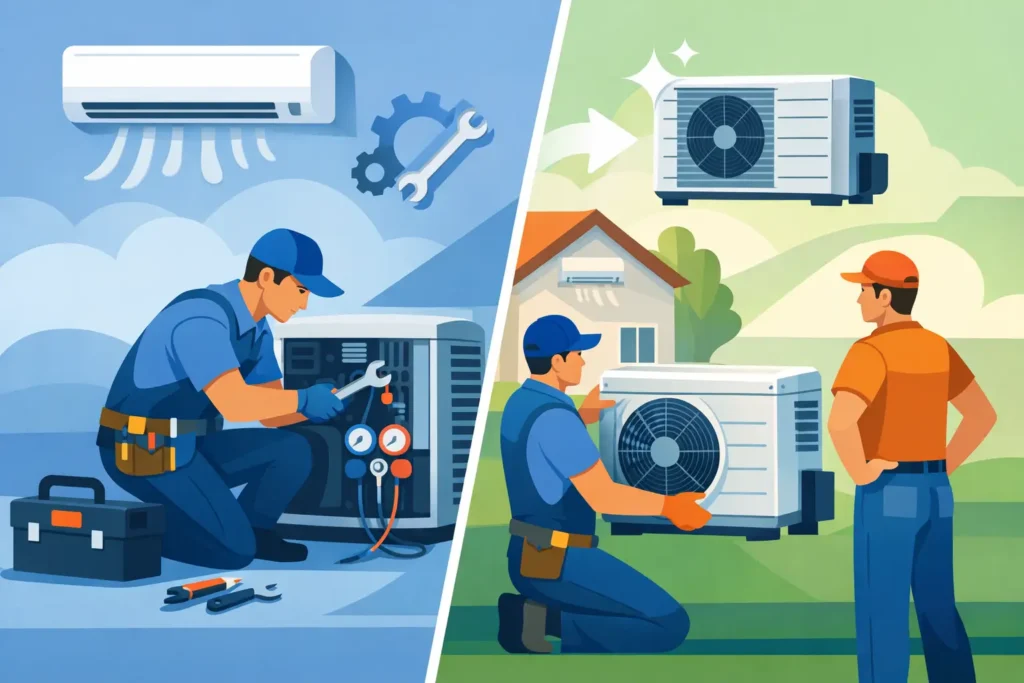
When an AC system stops cooling properly in peak summer, the decision is rarely just about restoring comfort. AC repair versus AC replacement affects tenant satisfaction, business continuity, electricity costs, maintenance budgets, and the long-term condition of your property. For homeowners, landlords, and facility managers in Dubai, the right answer depends on the unit’s condition, repair history, age, and ability to perform reliably under extreme heat.
A professional inspection should come before a major decision. Some faults are straightforward and economical to correct. Others are warning signs that the system has reached the point where continued repairs will cost more than planned replacement.
AC Repair Versus AC Replacement: Start With the Real Condition
An AC that blows warm air, runs continuously, leaks water, makes unusual noises, or trips electrical breakers needs technical attention. Those symptoms do not automatically mean the entire system must be replaced. A blocked drain line, failed capacitor, damaged contactor, dirty coil, thermostat issue, or refrigerant leak can often be repaired when identified early.
The key question is whether the repair addresses an isolated problem or extends the life of a system with multiple failing components. A qualified technician should assess the compressor, evaporator and condenser coils, fan motors, electrical controls, duct connections, insulation, drainage, refrigerant pressure, and airflow. For ducted systems, the inspection should also consider duct leakage, poor balancing, and contamination that may be reducing cooling performance.
A repair is usually the sensible choice when the unit has been maintained consistently, has no major compressor issue, uses an available refrigerant, and has several expected service years remaining. In these cases, timely repair can prevent a small defect from developing into a major breakdown.
Replacement becomes more practical when repeated faults are affecting operations or comfort. A system that needs emergency callouts every few months is not delivering dependable service, even if each individual repair appears affordable.
When AC Repair Is the Better Investment
Repair often makes financial sense for a relatively newer unit with a clear, limited fault. If the compressor is healthy, the system is properly sized for the space, and cooling performance was satisfactory before the issue occurred, a professional repair can restore reliable operation without the cost and disruption of replacement.
Consider repair when the issue involves a serviceable component, such as a fan motor, capacitor, thermostat, control board, drain pump, or minor refrigerant leak. These components can fail through normal wear, especially when AC systems operate for long periods in hot climates. Repairing them promptly also protects more expensive parts from strain.
Maintenance history matters. An AC that receives filter cleaning, coil cleaning, drain flushing, electrical checks, and regular performance testing is more likely to respond well to repair. Neglected units may have underlying problems caused by restricted airflow, dirt buildup, poor drainage, or overheating components. In that situation, fixing one part may not resolve the full issue.
For commercial properties, repair can also be appropriate when downtime must be minimized. A targeted repair may restore cooling quickly while the property team plans a future upgrade during a lower-occupancy period. This approach works best when the existing system can operate safely and reliably until replacement is scheduled.
Signs AC Replacement Will Deliver Better Value
Replacement should be considered when the system is near or beyond its typical service life, particularly if it has operated heavily in demanding conditions. Age alone is not the deciding factor, but an older AC with declining performance and recurring repairs is often more expensive to keep running than owners realize.
Frequent compressor problems are a major concern. The compressor is the central mechanical component of an AC system, and its failure can make a high-cost repair difficult to justify on an aging unit. The same applies when coils are severely corroded, refrigerant leaks are extensive, or essential parts are no longer readily available.
Obsolete refrigerant is another important factor. Older systems may rely on refrigerants that are increasingly difficult or costly to source. Repairing a leak in such a system may provide a temporary solution, but it does not eliminate the long-term availability and cost issue. A replacement system with current refrigerant technology is generally easier to service and better positioned for ongoing maintenance.
Poor energy performance is also a strong reason to upgrade. If an AC runs for long hours without reaching the set temperature, cycles on and off excessively, or produces uneven cooling across rooms, it may be consuming more electricity than necessary. Newer equipment can offer improved efficiency, better humidity control, and more consistent comfort when properly selected and installed.
Replacement is especially worth evaluating when your property is undergoing renovation, fit-out work, room additions, or changes in occupancy. An AC system that was suitable for the original layout may be undersized or poorly distributed after walls, ceilings, equipment loads, or usage patterns change.
Use Repair Cost as a Decision Tool, Not the Only Rule
Property owners often hear a simple guideline: replace the AC when a repair costs more than half the price of a new unit. This can be useful, but it is not enough on its own. A lower-cost repair may still be a poor decision if it is the third major repair in a year or if it does not address weak cooling, high electricity use, and aging equipment.
Instead, compare the full cost of keeping the current system. Include the immediate repair, likely future repairs, service callouts, energy consumption, downtime, and the risk of unexpected failure during peak heat. Then compare that figure with the installation cost, expected efficiency, warranty coverage, and service life of a replacement.
For landlords and facility managers, reliability has a measurable value. A breakdown in an occupied apartment, retail space, office, or staff accommodation can lead to complaints, disrupted work, and urgent after-hours expenses. A planned replacement gives you more control over scheduling and reduces the chance of a critical failure at the worst possible time.
Do Not Replace Equipment Before Checking the System Around It
A new AC unit cannot correct every cooling problem by itself. Duct leaks, blocked return-air paths, poor insulation, incorrect thermostat placement, dirty grills, and inadequate electrical capacity can all undermine performance. Replacing equipment without reviewing these conditions can result in a new unit that still struggles to cool the space evenly.
Correct sizing is equally important. An oversized AC may cool rooms too quickly without managing humidity properly and can cycle excessively. An undersized unit may run continuously, wear out sooner, and leave occupants uncomfortable. Load calculations should account for room size, ceiling height, glazing, sun exposure, insulation, equipment heat, occupancy, and the specific use of the area.
For centralized or ducted systems, a technical scope should include duct inspection, airflow balancing, drain routing, insulation condition, controls, and access for future maintenance. This is where working with a contractor that understands both AC systems and wider property maintenance can prevent fragmented work and avoidable rework.
A Practical Decision Process for Property Owners
Begin by requesting a documented diagnosis rather than approving a repair based only on a symptom. The report should explain what failed, why it failed, what the repair includes, and whether related components show signs of wear. Ask for clear options if replacement is also reasonable.
Next, review the system’s age and service record. One repair on a well-maintained system is different from repeated repairs on a unit with poor cooling, refrigerant loss, and electrical faults. Check recent electricity bills as well, especially if AC use has not changed but consumption has risen.
Then consider your property plans. If a villa renovation, office fit-out, or tenant turnover is approaching, replacement may be best coordinated with the project. If the current unit can be safely repaired and the property needs immediate cooling, repair may be the practical short-term step while an upgrade is planned properly.
Zillion Technical Services LLC can evaluate AC performance alongside duct servicing, electrical requirements, fit-out work, and broader maintenance needs, helping property owners manage the decision through one accountable technical partner.
The best choice is the one that restores dependable comfort without creating a larger cost problem a few months later. Repair a system that has a sound foundation and a clear, economical fault. Replace a system when reliability, efficiency, parts availability, or repeated failures show that it is no longer protecting your property’s comfort and operations.
