






A cooling system can have a well-maintained unit and still deliver uneven comfort, poor airflow, and higher utility bills. The reason is often hidden above ceilings and behind walls. If you are asking when should AC ducts be replaced, the answer depends less on their age alone and more on their condition, performance, and ability to support the building’s current cooling requirements.
For property owners and facility managers, duct replacement is a practical asset decision. Worn, leaking, contaminated, or poorly designed ductwork can make an AC system work harder than necessary while affecting indoor air quality and occupant comfort. Identifying the right time to replace it helps prevent recurring repair costs and unplanned downtime.
How Long Do AC Ducts Typically Last?
Properly installed metal ductwork can often last 20 to 30 years or longer. However, insulation, flexible duct sections, duct joints, sealing materials, and supporting components may deteriorate sooner. In high-use properties or hot climates where air conditioning operates for much of the year, wear can become apparent earlier.
Age is a useful starting point, but it is not a replacement rule. A 25-year-old duct system that is clean, sealed, correctly sized, and structurally sound may continue to perform well. Conversely, newer ducts may require replacement if the original installation was poor, moisture has entered the system, or renovation work has damaged the duct runs.
The best approach is a professional assessment that considers airflow, duct integrity, insulation condition, cleanliness, and the capacity of the current AC equipment.
Signs That AC Ducts Need Replacement
Duct problems often develop gradually, which makes them easy to overlook. Occupants may adjust thermostats, add portable fans, or request repeated AC servicing without realizing that the distribution system is the underlying issue.
The following signs indicate that replacement, rather than another minor repair, may be the better long-term solution:
- Uneven cooling across rooms. If some areas remain warm while others become excessively cold, ducts may be undersized, disconnected, crushed, leaking, or incorrectly balanced.
- Repeated dust buildup or musty odors. Excessive dust around vents, persistent odors, or visible debris inside supply registers can point to damaged insulation, contamination, or air leaks drawing particles into the system.
- Rising energy costs without a clear cause. Leaking ducts allow cooled air to escape into ceilings, shafts, or unconditioned spaces. The AC unit runs longer to meet the set temperature, increasing energy use.
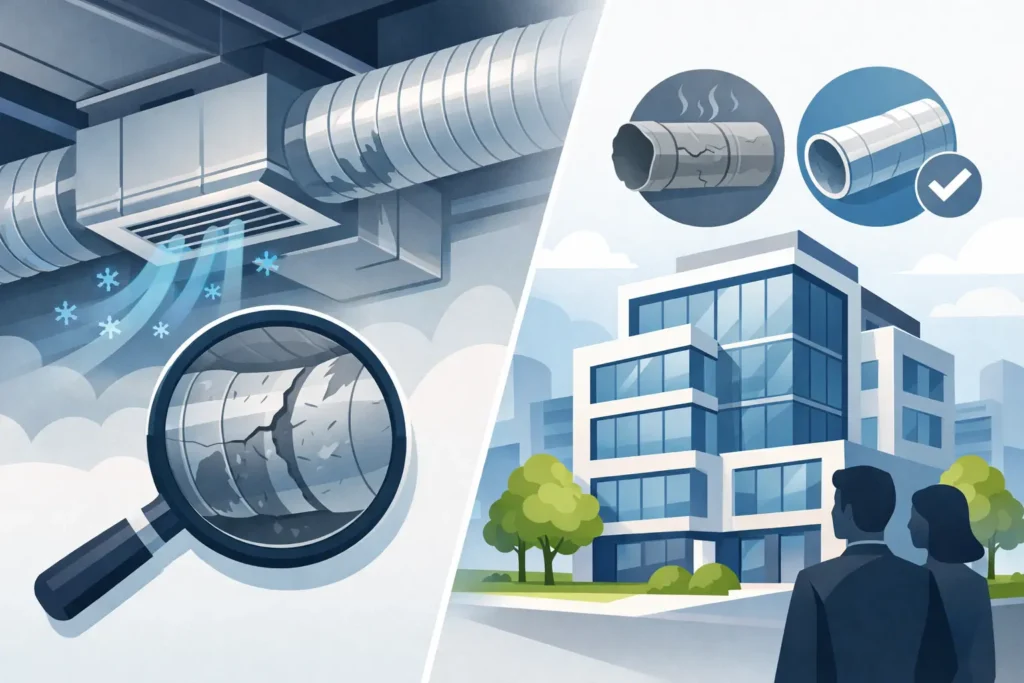
- Visible damage, corrosion, or deteriorated insulation. Rusted metal, torn flexible ducts, loose connections, sagging sections, wet insulation, and damaged vapor barriers should be addressed promptly.
- Frequent repairs in the same locations. If technicians repeatedly seal joints, reconnect ducts, repair insulation, or address airflow complaints, the system may have reached the point where partial fixes no longer offer value.
No single symptom automatically means every duct must be replaced. A localized leak may only need resealing, while widespread deterioration usually calls for a more complete duct replacement plan.
When Should AC Ducts Be Replaced Instead of Repaired?
The decision comes down to scope, reliability, and lifecycle cost. Repairs are appropriate when damage is limited and the duct design still supports the property’s needs. Sealing a few accessible joints, replacing a short damaged flexible section, or renewing insulation in one area can restore performance at a reasonable cost.
Replacement becomes more sensible when the duct system has multiple failures, inaccessible leaks, extensive corrosion, recurring moisture issues, or insulation damage across large areas. It is also worth considering when major renovations change room layouts, occupancy levels, or the function of the space. A duct layout designed for a small office, for example, may not properly serve a renovated workspace with meeting rooms, partitions, and higher heat loads.
Older ducts may also be incompatible with newer, more efficient AC equipment. Installing a high-efficiency unit while leaving poorly sized or leaking ducts in place can limit the expected savings. The equipment may be capable of better performance, but the distribution network remains the bottleneck.
Moisture and Mold Require Immediate Attention
Condensation inside or around ductwork is not a cosmetic issue. It can damage insulation, weaken duct materials, create odors, and support mold growth. In cooling-dominated climates, condensation commonly results from inadequate insulation, damaged vapor barriers, air leaks, blocked drainage, or incorrect temperature control.
If mold is suspected, the priority is identifying and correcting the moisture source. Cleaning a contaminated duct without resolving the cause can lead to the same problem again. Replacement may be necessary for porous insulation, heavily contaminated flexible ducts, or sections that cannot be effectively cleaned and dried.
A qualified technician should inspect related components as well, including supply and return grilles, drain lines, air handling units, insulation, and ceiling voids. This prevents a duct replacement project from treating only the visible symptom.
Poor Airflow May Be a Design Problem
Not all airflow problems come from aging ducts. Poor original design can affect a building from the first day of operation. Ducts that are too small restrict air volume and create noise. Oversized ducts can reduce air velocity and make balancing difficult. Sharp turns, long unsupported flexible runs, and poorly located return-air paths can further reduce system performance.
Replacement is often justified when a building has persistent comfort complaints despite regular servicing of the AC units. Before installing new ducts, technicians should review the cooling load, room use, equipment capacity, diffuser locations, return-air requirements, and available ceiling space. This helps ensure the new installation corrects the original issue rather than simply replacing old materials with the same flawed layout.
For commercial properties, this assessment is particularly valuable after fit-outs, tenant changes, or operational expansions. Server rooms, kitchens, retail spaces, clinics, and high-occupancy offices all place different demands on an AC distribution system.
What a Professional Duct Assessment Should Cover
A reliable duct replacement recommendation should be based on inspection findings, not assumptions. The assessment should examine accessible duct sections for leakage, corrosion, loose connections, crushed flexible ducts, failed insulation, and signs of water damage.
Technicians should also measure airflow and check whether individual spaces receive sufficient supply air. Temperature differences between rooms, noisy vents, weak airflow, and excessive system run times can help identify restrictions or design deficiencies. Where practical, inspecting concealed runs through access panels or cameras can reveal conditions that are not visible from registers alone.
The final recommendation should distinguish between repairs that can reasonably extend service life and defects that make replacement more cost-effective. It should also explain whether partial replacement is possible or whether the duct network should be upgraded as a coordinated system.
Plan Duct Replacement Around Other Property Work
Duct replacement can require access above ceilings, within shafts, or behind finishes. For that reason, it is often most efficient to schedule the work alongside renovations, ceiling repairs, insulation upgrades, AC equipment replacement, or interior fit-outs. Coordinating these activities reduces disruption and avoids reopening finished areas later.
Property managers should also consider operating hours, occupant needs, and the availability of temporary cooling for sensitive spaces. A planned project is typically less disruptive and more economical than emergency replacement after a major duct collapse, water event, or persistent indoor air quality complaint.
Zillion Technical Services LLC supports AC duct inspection, repair, installation, and related property maintenance work, helping clients coordinate technical upgrades with the wider needs of their building.
Protect Comfort Before Small Problems Grow
AC ducts are easy to ignore because they are mostly out of sight, but their condition has a direct effect on comfort, energy use, and indoor air quality. If recurring repairs, uneven cooling, leaks, moisture, or damaged insulation are becoming routine, a professional evaluation can clarify whether targeted repairs remain worthwhile or replacement is the more dependable path. Addressing the duct system before peak demand or a major renovation gives your property a stronger foundation for reliable cooling.
