





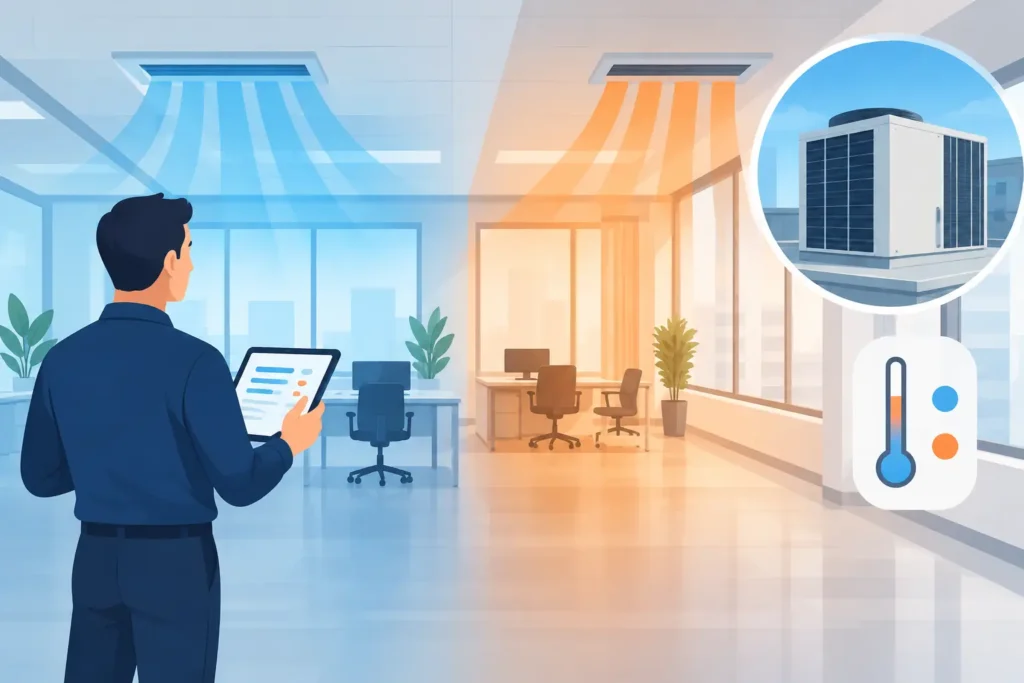
A meeting room that stays warm while the lobby feels cold is not just a comfort complaint. It can signal wasted energy, rising equipment strain, poor indoor air quality, or an HVAC fault that will become more expensive if left unresolved. Knowing how to diagnose uneven cooling helps property owners and facility teams identify whether the problem is local to one room or part of a larger system issue.
In hot climates, small performance gaps become noticeable quickly. A unit that is slightly underperforming, a blocked return grille, or a poorly balanced duct branch can leave occupants uncomfortable long before the thermostat shows an obvious failure. A systematic inspection produces better answers than repeatedly lowering the temperature setpoint.
Start by Defining the Uneven Cooling Pattern
Before inspecting equipment, record where and when the temperature difference occurs. Compare rooms at the same time of day, with doors and windows closed, and allow the system to run long enough to reach normal operation. A portable thermometer placed away from direct supply air, sunlight, and heat-producing equipment will provide a more reliable reading than a wall thermostat alone.
Look for patterns. Is one side of the building consistently warmer? Does the issue begin in the afternoon? Is it limited to upper floors, perimeter offices, bedrooms, or rooms furthest from the indoor unit? A room that is warm only during peak sun exposure may have an insulation, glazing, or shading issue. A room that remains warm at every hour is more likely to have an airflow, ductwork, control, or equipment problem.
Also ask occupants what they experience. A room can feel uncomfortable even when its measured temperature is close to the thermostat setting because humidity, direct sun, stagnant air, or a cold draft affects perceived comfort.
Check the Simple Causes First
Many uneven cooling calls begin with restrictions that are quick to correct. Start with the air filter. A loaded filter reduces airflow through the indoor unit and can make distant rooms noticeably warmer. Check that the filter is the correct size, seated properly, and replaced or cleaned according to the equipment requirement.
Next, inspect supply and return grilles. Supply grilles should be open, unobstructed, and able to direct air into the room. Return grilles need clear space around them to pull air back to the system. Furniture, storage boxes, curtains, and temporary partitions can restrict air circulation, especially in offices and retail spaces that change layout over time.
Check for closed or partly closed dampers if the system has accessible zone controls or manual balancing dampers. A damper adjusted during previous work may be limiting air to a particular room. Do not make major damper changes without documenting their original position. Balancing is interconnected, and sending more air to one area can reduce airflow elsewhere.
Compare Airflow Room by Room
Uneven cooling is often an airflow problem before it is a refrigerant problem. Stand below each supply grille while the system is running and compare the strength of the air stream. A simple tissue test can show whether air is moving, but it does not measure volume. For commercial properties, technicians use airflow instruments to confirm whether each diffuser is delivering the required amount of air.
Weak airflow in one room can point to a crushed flexible duct, loose duct connection, duct leakage, blocked branch, closed damper, or poorly designed duct run. In ceiling voids, damaged insulation around ducts can also allow conditioned air to gain heat before it reaches the occupied space.
If several rooms have weak airflow, inspect the indoor fan section, filter condition, evaporator coil cleanliness, and return-air path. A dirty coil restricts air movement and reduces heat transfer. The fan may still run, but it cannot move enough conditioned air to serve the building evenly.
Watch for Supply-Air Temperature Differences
Air coming from supply grilles should feel consistently cool when the system is in cooling mode. If air from one grille is warmer than air from others connected to the same system, the branch duct, damper, or local zone control needs attention. If all supply air feels only mildly cool, the issue may be at the central unit rather than in the duct distribution.
Technicians assess the temperature difference between return air and supply air, along with airflow, humidity, and operating pressures. A temperature reading alone is not enough to diagnose refrigerant charge or compressor health. Accurate diagnosis requires the full operating picture.
Inspect Thermostats and Zone Controls
A thermostat can create uneven cooling when it is installed in the wrong location or is reading inaccurate conditions. A thermostat near a kitchen, exterior glass, copier, server cabinet, or supply diffuser may sense temperatures that do not represent the occupied area. The system may shut down while other rooms remain warm, or it may continue running after the controlled zone is already cold.
For buildings with multiple thermostats or a building management system, compare setpoints, schedules, and operating modes. A common issue is a zone scheduled to switch off earlier than adjacent areas. Another is a failed actuator that does not open or close its zone damper as commanded.
Check for these control-related issues:
- Different temperature setpoints or cooling schedules between zones
- Thermostat batteries, wiring, or sensor calibration problems
- Zone dampers that are stuck, disconnected, or incorrectly configured
- Sensors exposed to direct sunlight, equipment heat, or supply-air drafts
Smart controls can improve comfort, but only when sensors, dampers, and schedules are commissioned correctly. Changing a setpoint may hide the symptom without correcting the cause.
Look Beyond the HVAC System
Not every warm room has a mechanical fault. Heat gain can exceed the cooling capacity delivered to that space. This is common in rooms with large west-facing windows, roof exposure, insufficient insulation, frequent door opening, or high internal loads from people and equipment.
A server room, commercial kitchen, gym area, or meeting room with high occupancy needs more cooling than a standard office of the same size. If the usage of a space has changed after a fit-out or renovation, the original HVAC design may no longer match the actual load.
Check doors and windows for gaps, damaged seals, and air leakage. In a commercial entrance, an air curtain or properly operating door system can reduce the amount of hot outside air entering the space. For residential properties, window treatments and insulation improvements may reduce afternoon heat gain, though they will not fix a blocked duct or failing AC unit.
Know When the Main AC Unit Needs Service
When the entire property cools poorly, or when cooling performance has declined across multiple zones, inspect the AC unit. Warning signs include ice on refrigerant lines or the indoor coil, water leakage, unusual noise, frequent cycling, electrical odor, or a sharp increase in power consumption.
Low refrigerant can reduce cooling capacity, but it is not a routine consumable. If refrigerant is low, there may be a leak that needs to be located and repaired before the system is recharged. Adding refrigerant without leak testing can create a repeat failure and unnecessary operating cost.
Condenser coils also require attention. Outdoor units reject heat through their coils, and dust, debris, or poor clearance around the unit can reduce their ability to do so. In dusty environments, regular cleaning is part of maintaining reliable cooling performance. Electrical components, capacitors, fan motors, compressors, and condensate drainage should be checked by qualified technicians.
Use Professional Testing for Persistent Problems
A proper diagnosis is more than a visual inspection. For recurring uneven cooling, a qualified HVAC team should assess supply and return temperatures, airflow volume, static pressure, duct leakage, coil condition, refrigerant circuit performance, electrical readings, thermostat calibration, and zone damper operation.
This approach matters in larger homes, offices, retail units, and facilities where comfort complaints can affect tenants, customers, and staff productivity. It also helps distinguish between a repairable fault and a design limitation that requires duct modification, rebalancing, additional capacity, or control upgrades.
Zillion Technical Services LLC can investigate uneven cooling as part of AC servicing and ongoing maintenance support, helping property teams address the source of the issue rather than relying on temporary thermostat adjustments.
A cooler room should not come at the expense of a warmer one. Addressing airflow, controls, heat gain, and equipment condition early keeps occupants comfortable and gives your HVAC system a better chance to operate efficiently through demanding weather.
