







A roof rarely fails all at once. It starts with a small blister in the membrane, a hairline crack near a drain, or standing water that stays a day too long after rain. In a hot, demanding climate, roof waterproofing solutions are not just a repair category. They are part of protecting the building envelope, controlling maintenance costs, and avoiding disruption to tenants, operations, and interiors.
For property owners and facility managers, the real question is not whether a roof needs protection. It is which system fits the roof type, the building use, and the condition of the structure underneath. The right choice can extend service life and reduce recurring repairs. The wrong one can trap moisture, fail under UV exposure, or create a cycle of patchwork that costs more over time.
Why roof waterproofing solutions matter
A leaking roof does more than stain a ceiling. Water intrusion can damage insulation, corrode embedded metal, weaken concrete, affect indoor air quality, and interfere with electrical systems. On commercial properties, even a minor leak can interrupt business activity or damage inventory and equipment. On residential properties, it often shows up only after moisture has already spread beyond the original entry point.
That is why roof waterproofing should be approached as a technical system, not a cosmetic coating. Surface appearance alone does not confirm performance. A roof may look intact and still fail at laps, penetrations, upstands, expansion joints, or drainage points. These transition areas are where many waterproofing problems begin.
Common roof waterproofing solutions and where they fit
No single waterproofing method suits every roof. The best option depends on whether the roof is flat or sloped, exposed or tiled, new or aging, and whether the existing substrate is concrete, metal, screed, or another material.
Liquid-applied waterproofing membranes
Liquid-applied systems are widely used because they create a continuous membrane with fewer seams than sheet systems. When installed correctly, they can conform well around pipes, corners, and complex detailing. This makes them practical for roofs with multiple penetrations or irregular layouts.
Their performance, however, depends heavily on surface preparation and film thickness. If the substrate is dusty, damp, unstable, or uneven, the membrane may not bond properly. These systems are also not all the same. Some are better suited to UV exposure, some handle foot traffic better, and some are more flexible over time. Choosing by price alone usually leads to premature failure.
Bituminous membrane systems
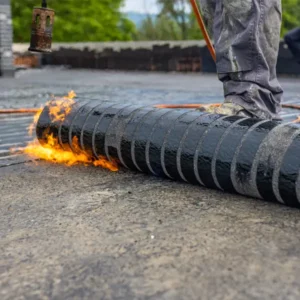
Bituminous membranes remain a proven choice for many flat roofs. They are known for durability and can perform well when properly installed with strong seam integrity. For larger areas with straightforward geometry, they are often a practical and cost-effective option.
The trade-off is that detailing matters a great deal. Edges, overlaps, drains, and terminations must be handled with precision. On an older roof, the substrate condition becomes especially important because the membrane is only as reliable as the base it is bonded to. If moisture is already trapped below, simply covering the surface may not solve the problem.
Cementitious waterproofing
Cement-based systems are often used where compatibility with concrete is a priority. They can be useful on certain roof slabs, parapets, and service areas, especially when paired with the correct protective finish.
That said, cementitious products are not always the best answer for roofs exposed to constant thermal movement. Roof surfaces expand and contract significantly under heat. If the selected system does not accommodate movement, cracking can develop and water will find its way through. In those cases, flexibility matters more than surface hardness.
Polyurethane and elastomeric coatings
For roofs exposed to intense sunlight and temperature fluctuation, polyurethane and elastomeric systems are often considered because of their flexibility and weather resistance. These coatings can bridge minor cracks and help create a reflective surface, which may also support better thermal performance depending on the specification.
But they are not a shortcut. If ponding water is present or the roof slope is inadequate, even a quality coating may struggle over time. Waterproofing works best when paired with good drainage design, not used to compensate for poor falls or blocked outlets.
How to choose the right roof waterproofing solution
The first step is diagnosis, not product selection. A roof should be assessed for visible leaks, substrate condition, cracks, membrane separation, previous repair history, drainage efficiency, and signs of trapped moisture. Without that assessment, it is easy to treat symptoms while missing the actual failure point.
Building use also matters. A warehouse, villa, retail unit, and residential tower do not carry the same risk profile. If roof access is frequent for AC servicing or equipment maintenance, the waterproofing system should account for traffic and protection. If the roof supports mechanical systems, detailing around supports and penetrations becomes more critical. If the building cannot tolerate downtime, phased work and fast-curing materials may be part of the decision.
Budget should be considered in terms of lifecycle cost, not just installation cost. A lower upfront quote may exclude proper surface preparation, crack treatment, slope correction, or reinforcement at weak points. Those omissions usually reappear later as call-backs, interior repairs, and another waterproofing job sooner than expected.
Roof waterproofing solutions fail when preparation is ignored
Most waterproofing failures are not caused by the product name on the label. They come from weak execution. Dusty surfaces, unsealed cracks, poor adhesion, incorrect mixing ratios, rushed curing, and careless detailing can compromise an otherwise suitable system.
Drainage is another common issue. If roof drains are undersized, blocked, or poorly positioned, standing water increases the stress on the waterproofing layer. Likewise, parapet-wall junctions and service penetrations are often vulnerable because they involve movement, multiple materials, and difficult access.
A professional approach includes substrate repair, cleaning, moisture checks where needed, proper priming, treatment of joints and corners, and quality control during application. These steps are not optional extras. They are what make the waterproofing system perform as designed.
Repair or full replacement?
It depends on the condition of the existing roof. Localized repairs can be effective when the waterproofing system is generally sound and the failure is isolated to a few identifiable areas. This approach can control costs and reduce disruption.
If leaks are recurring in multiple zones, if the membrane has aged broadly, or if moisture has spread under the system, patching may only delay a larger problem. In those cases, a full replacement or a structured rehabilitation strategy is usually the more reliable option. The right recommendation should come from inspection findings, not a one-size-fits-all sales pitch.
What good waterproofing work should deliver
A properly selected and installed roof waterproofing system should do more than stop current leaks. It should create a stable, maintainable barrier that performs under heat, rain, UV exposure, and routine service activity. It should also reduce emergency maintenance and support the long-term condition of the building below.
For clients managing multiple property needs, working with a contractor that understands waterproofing in relation to HVAC access, roof equipment, structural detailing, and ongoing maintenance brings real value. This is where a one-stop technical partner can simplify planning and reduce coordination issues across trades. Companies such as Zillion Technical Services LLC are positioned around that practical advantage – handling waterproofing as part of the larger performance of the property, not as an isolated task.
When to schedule roof waterproofing work
The best time is before interior signs appear. If you notice surface cracks, bubbling, peeling coatings, damp smells on upper floors, repeated ceiling stains, or water collecting on the roof after rain, the roof should be inspected. Waiting rarely improves the outcome. Water moves, spreads, and finds weak points.
Preventive inspection is especially useful for older buildings and properties with heavy rooftop equipment. Even when there is no active leak, early intervention can preserve the substrate and avoid a more disruptive project later.
A dependable waterproofing plan starts with clear assessment, the right material for the roof, and workmanship that respects the details. If the goal is fewer surprises and longer roof life, the smartest move is to treat the roof before it forces the issue.
