





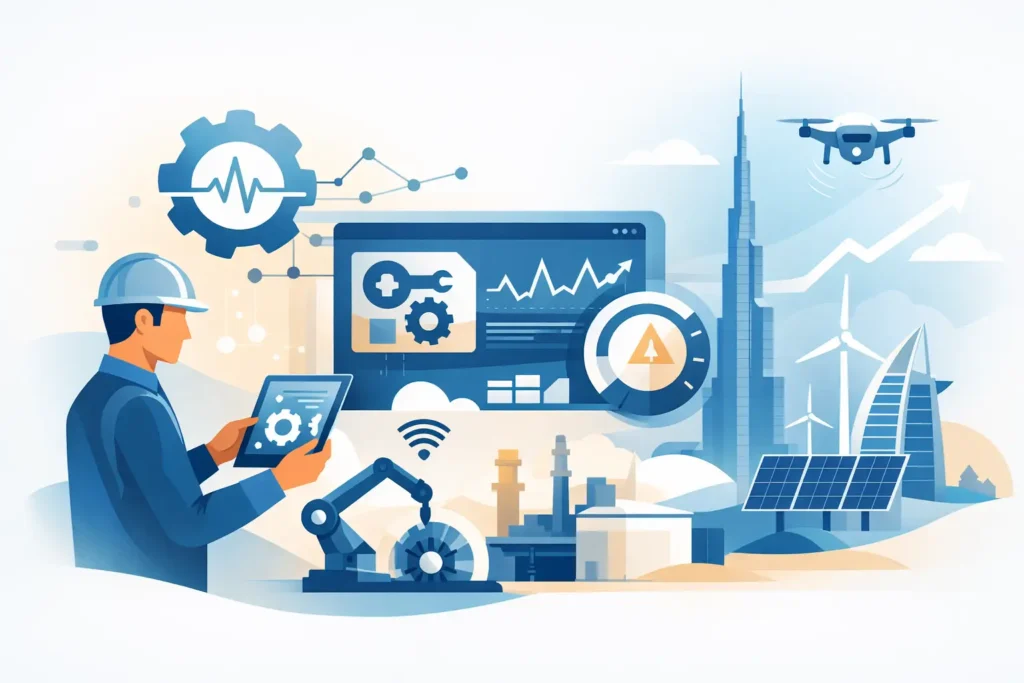
A failed AC unit during a Dubai summer afternoon is not a minor inconvenience. For a retail store, office, villa, hotel, or residential tower, it can mean discomfort, lost business, tenant complaints, water damage from condensate issues, and an urgent callout at the worst possible time. Predictive maintenance technology is designed to reduce that risk by identifying warning signs before equipment reaches the point of failure.
For property owners and facility managers, the value is practical: fewer surprises, better control of maintenance budgets, and more time to plan repairs around building operations. It does not replace skilled technicians or regular inspections. It gives them better information about where attention is needed first.
What Predictive Maintenance Technology Does
Traditional maintenance generally follows one of two models. Reactive maintenance begins after something breaks. Preventive maintenance follows a fixed schedule, such as servicing an AC system every few months whether its condition requires immediate intervention or not.
Predictive maintenance technology takes a condition-based approach. It uses equipment data, inspections, and performance trends to estimate when a component may need service. Sensors, connected controllers, energy meters, vibration monitors, temperature readings, pressure data, and water-quality measurements can all provide useful signals.
The objective is not to predict every failure with absolute certainty. Building systems are affected by installation quality, operating hours, weather, occupancy, equipment age, and how consistently previous maintenance was completed. The objective is to spot abnormal behavior early enough to intervene before it develops into a costly breakdown.
For example, an air-conditioning unit that is drawing more electrical current than usual while delivering less cooling may be showing early signs of a dirty coil, airflow restriction, refrigerant issue, or deteriorating motor. A fixed maintenance schedule might not flag the change until the next visit. Condition data can prompt a technician to investigate while the unit is still operating.
Why It Matters in UAE Properties
High temperatures, dust, humidity, and heavy cooling demand place continuous pressure on building assets in the UAE. HVAC systems often operate for long hours, and even a small drop in efficiency can increase energy consumption and affect occupant comfort. Pumps, pool filtration equipment, water heaters, exhaust systems, and electrical components face their own operating stresses.
In this environment, waiting for visible failure is expensive. A blocked drain line may become a ceiling leak. A worn pump bearing may lead to a full pump failure. Poor air flow can put unnecessary strain on compressors and fans. Predictive maintenance helps move maintenance decisions closer to the first signs of deterioration rather than the final stage of damage.
It is especially useful for facilities with assets that are difficult to shut down, expensive to replace, or essential to daily operations. A commercial kitchen exhaust system, a swimming pool circulation pump, a central air-conditioning plant, or a building booster pump may all justify closer monitoring because downtime has consequences beyond the repair bill.
Where Predictive Maintenance Delivers the Most Value
Not every asset needs a sensor package or advanced analytics. The right investment depends on the asset’s criticality, replacement cost, failure history, and effect on operations. A small residential exhaust fan may be managed effectively through routine inspection. A large chilled-water pump serving a commercial building deserves a more detailed condition-monitoring plan.
HVAC and Air-Conditioning Systems
Air-conditioning is often the strongest starting point. Technicians can track supply and return air temperatures, filter condition, refrigerant pressures, motor load, vibration, drainage performance, and operating run time. Changes in these readings can reveal efficiency losses before occupants report that rooms are not cooling properly.
For split units and ducted systems, the approach may be simple: consistent service records, visual inspections, temperature checks, and documented electrical readings. For larger systems, building management system data and connected sensors can provide a more continuous view of performance.
The benefit is not only breakdown prevention. A system operating with poor airflow, dirty coils, or incorrect settings can consume more energy while providing less comfort. Early correction protects equipment life and supports more efficient operation.
Pumps, Water Systems, and Pools
Water systems provide clear warning signs when they are monitored properly. Fluctuating pressure, abnormal vibration, longer pump run times, leaks, repeated tripping, or declining water flow can indicate developing problems in pumps, valves, filters, or controls.
For swimming pools, maintenance teams can monitor circulation performance, filter pressure, water level, chemical balance, and pump operation. A pool may still look acceptable while filtration performance is declining. Addressing the issue early helps protect water quality, equipment condition, and the guest or resident experience.
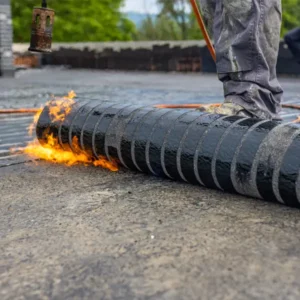
Waterproofing also benefits from a predictive mindset, although the technology is different. Moisture inspections, drainage checks, roof condition assessments, and prompt investigation of recurring damp patches can prevent a minor defect from becoming widespread damage to finishes, ceilings, and structural surfaces.
Electrical and Mechanical Equipment
Electrical panels, motors, fans, and air curtains can be monitored through load readings, thermal inspection, run hours, and recurring fault records. Excess heat in a connection, unusual motor vibration, or repeated overload trips should not be treated as isolated events. These are maintenance signals that require diagnosis.
For facilities with multiple sites, recording these findings in one maintenance system makes patterns easier to see. If the same equipment type fails repeatedly across several locations, management can determine whether the cause is usage, installation, poor component quality, or a gap in the maintenance routine.
Data Is Useful Only When It Leads to Action
Installing sensors is not a maintenance strategy by itself. A dashboard full of readings does not protect a property if no one reviews exceptions, verifies alarms, and assigns corrective work. The operational process behind the technology matters as much as the technology itself.
A practical program begins with an asset register. Each major system should have clear identification, location details, service history, warranty information where available, and an assessment of how critical it is to the property. The maintenance team can then establish normal operating ranges and define which changes require inspection.
The next step is assigning responsibility. Someone must review alerts, confirm whether the reading is reliable, and decide whether the issue needs immediate attention, a scheduled repair, or continued observation. This prevents two common problems: ignoring meaningful alarms and sending technicians to every minor fluctuation.
Service documentation closes the loop. When technicians record the fault found, corrective action completed, parts used, and post-repair readings, the property builds a more accurate picture of its equipment. Over time, this history improves maintenance planning and helps identify assets that are approaching replacement rather than another repair.
The Trade-Offs to Consider
Predictive maintenance technology requires investment. Costs may include sensors, connectivity, software, integration with existing controls, training, and ongoing data review. For a small property with basic equipment, a disciplined preventive maintenance contract and careful technician reporting may deliver most of the benefit without a complex system.
Data quality is another consideration. A poorly installed sensor, incorrect equipment label, or missing service record can produce misleading conclusions. Technology should support qualified technical judgment, not replace it. An experienced technician still needs to inspect the equipment, understand the operating conditions, and confirm the actual cause of a warning.
There is also a difference between monitoring and prediction. Reading a temperature once a month is useful monitoring. Comparing thousands of operating readings over time to identify unusual patterns is closer to predictive maintenance. Properties should choose a level of sophistication that fits their asset base and operational needs.
How to Introduce It Without Disrupting Operations
Start with the equipment that causes the greatest disruption when it fails. Review recent callouts, emergency repairs, tenant complaints, utility costs, and recurring faults. This usually reveals a short list of systems where early warning would have real value.
Then establish a baseline. Before relying on alerts, verify that the equipment is properly maintained and collect reliable readings during normal operation. A baseline makes it easier to identify what has actually changed.
Use a phased rollout rather than applying the same solution to every asset. Monitor a group of critical AC units, pumps, or electrical systems first. Review whether the alerts resulted in useful interventions, reduced emergency work, or improved energy performance. The results will show where expansion is justified.
A capable maintenance partner can combine technology with on-site expertise. Zillion Technical Services LLC can support this approach through planned inspections, documented service records, condition checks, and coordinated technical work across HVAC, plumbing-related systems, electrical support, pools, waterproofing, and general property maintenance.
The most useful first question is not which sensor to buy. It is which equipment failure would cause the most disruption to your property this month. Start there, build a clear service history, and give your maintenance team the information needed to act before a small warning becomes an urgent repair.
