





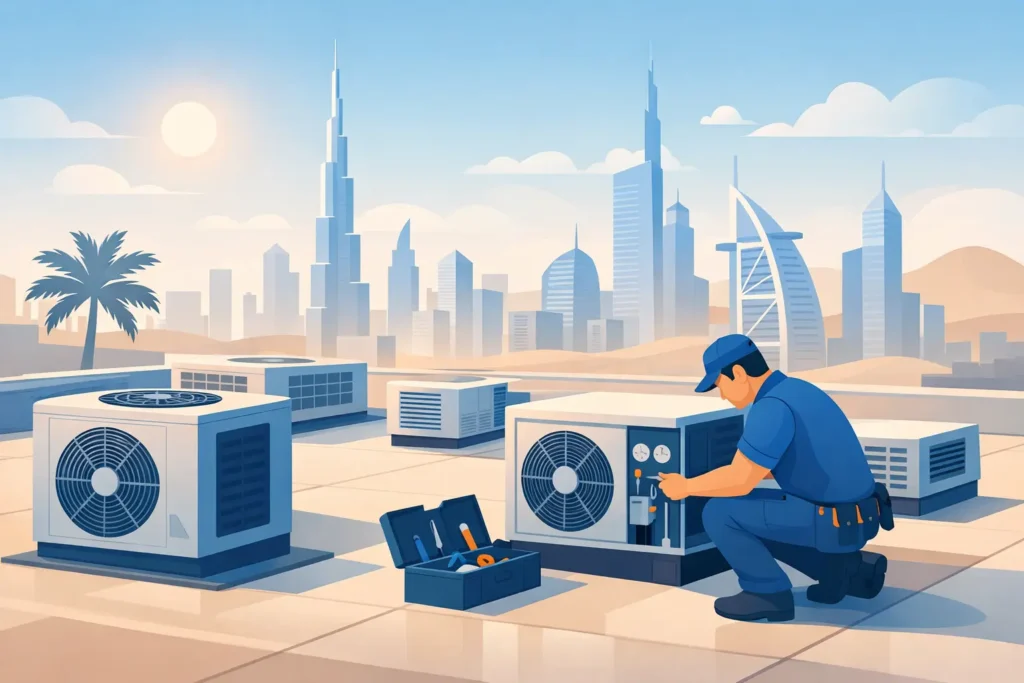
A rooftop AC unit can appear to be working normally while losing capacity, consuming excess electricity, or developing a fault that will stop cooling when the building needs it most. In a hot, dusty climate such as Dubai, knowing how to maintain rooftop ac units is essential for property owners and facility managers who want dependable comfort, lower operating costs, and fewer emergency callouts.
Rooftop units operate in one of the harshest locations on a property. They are exposed to direct sun, airborne dust, humidity, wind-driven debris, and long operating hours. A practical maintenance plan protects the equipment, but it also protects business continuity, tenant satisfaction, and the life of the entire HVAC system.
Why Rooftop AC Maintenance Requires a Different Approach
Unlike indoor split systems, rooftop packaged units combine major components in one outdoor cabinet. Depending on the system, that cabinet may contain compressors, condenser coils, evaporator sections, supply and return fans, filters, belts, dampers, electrical controls, and drainage components.
That design is convenient for commercial properties, warehouses, retail units, villas, and low-rise buildings, but it also means one neglected issue can affect several functions at once. A clogged condenser coil raises head pressure and forces the compressor to work harder. A loose fan belt reduces airflow and can cause the evaporator coil to freeze. A blocked drain can introduce water damage or indoor humidity problems.
Maintenance should therefore focus on complete system performance, not only whether cold air is coming from the supply grilles. A unit may still cool while operating inefficiently, and that is often when avoidable wear begins.
How to Maintain Rooftop AC Units: A Practical Schedule
The right schedule depends on unit age, occupancy, operating hours, local dust exposure, and whether the system serves critical spaces. A restaurant, clinic, server room, or occupied commercial facility usually needs closer attention than a lightly used storage area. In the UAE, quarterly professional servicing is a sensible baseline for many rooftop systems, with filter checks and visual inspections carried out more frequently.
Start With Safe Access and Visual Checks
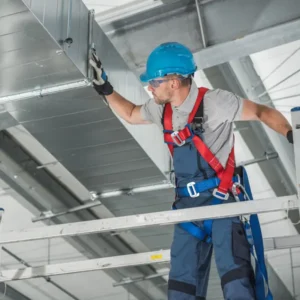
Rooftop work should only be performed by trained personnel with safe roof access and the correct electrical isolation procedures. Before opening a unit, inspect the area around it. Remove loose debris, leaves, packaging, and any items that restrict airflow around condenser sections or service panels.
Check that the unit cabinet is secure, panels are properly fastened, and weather seals are intact. Rust, damaged insulation, loose screws, deteriorated gaskets, or standing water near the curb deserve early attention. Small enclosure issues can allow water, dust, and pests into electrical and mechanical sections.
The roof itself also matters. Drain outlets near the unit must remain clear, and any signs of water ponding should be investigated. Rooftop AC maintenance and roof maintenance often overlap, particularly where waterproofing, pipe penetrations, and condensate drainage are involved.
Clean or Replace Air Filters on Time
Dirty filters are among the most common causes of weak airflow, poor indoor air quality, and unnecessary energy use. When filters become loaded with dust, the supply fan must work harder to move air through the system. Reduced airflow may also cause coil icing and uneven cooling across the building.
Inspect filters monthly during periods of heavy use. Replace disposable filters when they are visibly dirty or when pressure readings indicate restriction. Washable filters must be cleaned thoroughly, dried completely, and reinstalled correctly. Using the wrong filter type or fitting it improperly can allow dust to bypass the filter and settle on the evaporator coil.
For facilities with high dust loads, frequent door traffic, cooking activity, or renovation work nearby, standard monthly checks may not be enough. Filter replacement intervals should reflect actual site conditions rather than a fixed calendar date.
Keep Coils Clean and Airflow Unrestricted
Condenser coils release heat from the refrigerant to the outside air. Dust and grime on these coils form an insulating layer that prevents efficient heat transfer. The result is higher power consumption, reduced cooling output, and increased stress on compressors.
Professional technicians should inspect condenser and evaporator coils during planned service visits. Coil cleaning requires the correct method and cleaning solution because high-pressure washing, harsh chemicals, or careless brushing can bend fins and damage the coil surface. Bent fins should be straightened where practical to restore airflow.
The condenser fan and its guard also need inspection. Unusual vibration, damaged blades, bearing noise, or poor fan speed can quickly affect system pressures. A clean coil will not solve an airflow problem caused by a failing fan motor.
Inspect Belts, Motors, and Fan Assemblies
Many rooftop units use belts to drive supply or return fans. Belts naturally wear, stretch, and crack over time. A belt that is too loose can slip and reduce airflow, while one that is too tight can overload motor bearings.
During maintenance, technicians should inspect belt condition, alignment, and tension, then check pulleys, bearings, mounts, and motor operation. Any vibration should be traced to its source rather than treated as normal rooftop equipment noise. Vibration can loosen electrical connections, damage components, and shorten the service life of motors and fans.
Direct-drive systems do not have belts, but they still require motor, bearing, blade, and mounting inspections. The maintenance task changes with the equipment design, but the goal remains the same: stable airflow at the intended volume.
Check Electrical Components and Controls
Heat, vibration, and continuous operation can affect electrical connections inside rooftop units. A planned inspection should include contactors, capacitors, relays, overload devices, circuit breakers, wiring insulation, and terminal tightness. Burn marks, swollen capacitors, damaged wire insulation, or repeated tripping are warning signs that need immediate professional assessment.
Technicians should also verify thermostat operation, control settings, sensors, economizer dampers where installed, and staging of compressors or cooling circuits. Incorrect controls can lead to short cycling, inconsistent temperatures, and higher energy consumption even when the mechanical system is in good condition.
Property teams should avoid repeatedly resetting tripped breakers or bypassing safety controls to keep a unit running. Those protections exist to prevent a minor fault from becoming compressor damage or an electrical hazard.
Monitor Refrigerant Performance and Drainage
Low refrigerant is not a routine condition. If refrigerant readings are low, the system may have a leak that should be located and repaired by a qualified HVAC technician. Simply adding refrigerant without addressing the cause can create repeat failures and additional operating cost.
A technician should assess operating pressures, superheat, subcooling, compressor amp draw, and supply-air temperature against the unit’s specifications. These readings help identify issues that cannot be seen during a visual inspection.
Condensate drains and pans also require regular attention. Clear the drain line, inspect the pan for corrosion or cracks, and confirm that water flows away correctly. In humid conditions, blocked drains can cause overflow, odor, biological growth, and damage to ceilings or internal finishes below.
Build Maintenance Around Operating Evidence
The most effective maintenance plans combine scheduled service with simple operational records. Log filter changes, coil cleaning, electrical readings, refrigerant work, parts replaced, reported temperature complaints, and unexpected shutdowns. Over time, this record helps identify whether a unit is becoming unreliable or whether a recurring issue is linked to controls, ductwork, power quality, or building use.
Watch for higher electricity consumption, longer cooling cycles, hot and cold zones, water leaks, new noises, or frequent thermostat adjustments. These are not always signs of major failure, but they are reasons to inspect the system before peak demand exposes the problem.
For multi-property owners and facility managers, an annual maintenance contract can make this process more controlled. A qualified provider can schedule inspections, document findings, prioritize repairs, and coordinate related works such as duct servicing, electrical repairs, waterproofing around roof penetrations, and general property upkeep. Zillion Technical Services LLC supports this coordinated approach for properties that need consistent technical coverage rather than disconnected reactive repairs.
When Repair Is No Longer the Best Option
Maintenance extends equipment life, but it cannot make an outdated or severely damaged unit efficient forever. Consider a repair-versus-replacement assessment when compressor failures repeat, corrosion affects critical sections, spare parts are difficult to source, cooling capacity no longer matches the space, or repair costs continue to rise.
Replacement decisions should account for more than the purchase price. A correctly sized modern unit can reduce energy use, improve controls, and deliver more dependable comfort. However, replacement should be based on load calculations, duct condition, electrical capacity, roof structure, and access requirements – not on tonnage alone.
A rooftop unit is easy to overlook because it sits out of sight. Treat it as a critical building asset instead. Regular inspection, clean airflow paths, accurate technical testing, and timely repairs will keep cooling dependable when your property cannot afford disruption.
