






If some rooms cool quickly while others stay warm, the problem is often not the AC unit itself. In many properties, the issue starts with poor duct design, aging duct runs, air leakage, or incorrect sizing. A professional air conditioner ducting installation service addresses the full airflow path, helping your system deliver consistent cooling where it is actually needed.
In Dubai and across the UAE, ductwork does more than move air from one point to another. It directly affects comfort, indoor air quality, energy use, and the day-to-day performance of your AC system. For property owners, landlords, facility managers, and commercial operators, well-installed ducting is not just a technical detail. It is part of keeping the building reliable, efficient, and easier to manage.
Why ducting installation matters more than many property owners expect
An air conditioning system can only perform as well as the duct network connected to it. Even a high-quality unit will struggle if the duct layout is poorly planned, if bends are too sharp, if insulation is inadequate, or if connections leak cooled air before it reaches the occupied space.
That is why ducting installation should never be treated as an afterthought during fit-out, renovation, or AC replacement work. Good ductwork supports balanced airflow, stable room temperatures, cleaner air circulation, and better system efficiency. Poor ductwork does the opposite. It can lead to hot spots, excess strain on equipment, higher utility costs, and more frequent maintenance issues.
This becomes especially relevant in larger villas, offices, retail units, warehouses, and mixed-use buildings where cooling demands vary by room use, occupancy, and sun exposure. A one-size-fits-all approach rarely works. The duct design has to match the building layout and the actual load requirements.
What a proper air conditioner ducting installation service should include
A reliable air conditioner ducting installation service starts with assessment, not guesswork. The first step is understanding the property, the AC capacity, the number of zones, ceiling conditions, and how air should move through the space. Without that, even clean-looking installation work may fail in practical use.
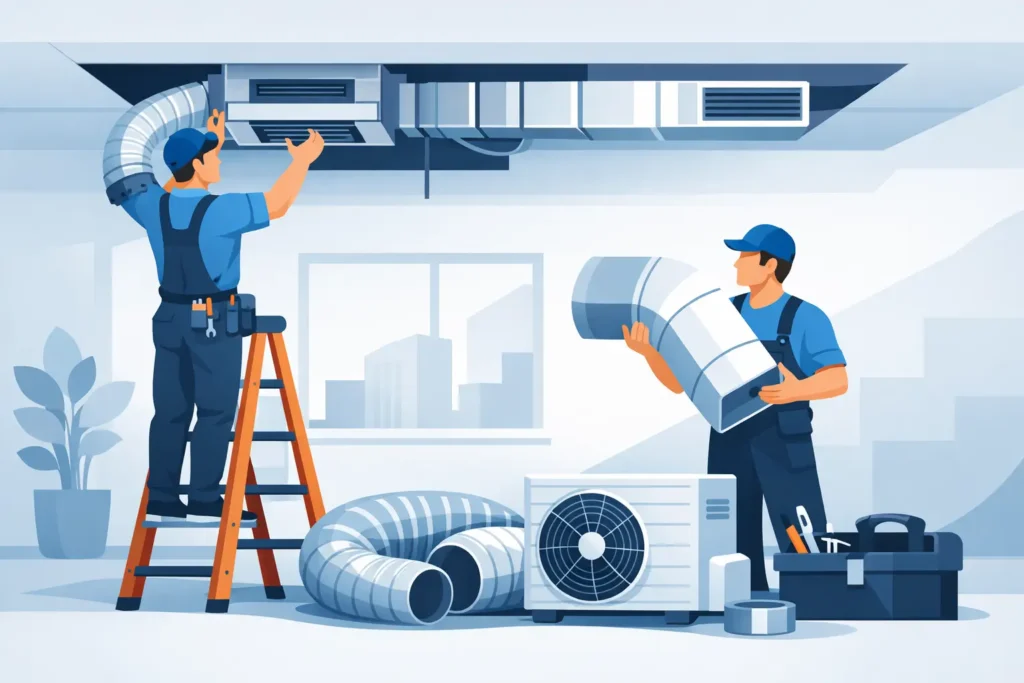
A proper service usually includes duct routing, sizing, fabrication or selection of suitable duct material, insulation, diffuser and grille positioning, and secure sealing at joints and connections. It should also consider access for future maintenance. Ducting that is impossible to inspect or service can create avoidable problems later.
Testing is another essential part of the job. Airflow needs to be checked after installation to confirm that the system performs as intended. If airflow is weak at the far end of a duct run or if certain rooms are over-supplied while others are under-cooled, adjustments should be made before the project is considered complete.
The most common ducting problems in residential and commercial properties
In existing properties, many airflow complaints trace back to a few recurring issues. One is leakage at joints, where conditioned air escapes into ceiling voids or service areas instead of occupied rooms. Another is undersized or oversized ducting, both of which affect pressure and air distribution.
Insulation problems are also common. In the UAE climate, poor insulation can reduce cooling efficiency and increase condensation risk. Over time, that can affect surrounding finishes and contribute to maintenance concerns.
Then there is layout. Duct routes that are too long, poorly supported, or designed with unnecessary bends can restrict airflow. In commercial settings, modifications made during tenant fit-outs sometimes make the problem worse. A partition gets added, a diffuser is moved, occupancy changes, but the ducting is left as-is. The result is an AC system that no longer matches the space it serves.
Air conditioner ducting installation service for new projects and upgrades
For new properties, ducting installation is an opportunity to get the cooling infrastructure right from the start. That means coordinating the duct system with ceiling design, electrical planning, and overall MEP requirements. When the work is planned properly, the system is cleaner, more accessible, and more efficient.
For older properties, the need is often different. The project may involve replacing damaged duct sections, correcting design faults, improving insulation, or reworking the layout to support a renovated space. In these cases, the right solution depends on the condition of the existing system. Full replacement is not always necessary, but patchwork repairs are not always enough either.
This is where technical assessment matters. A dependable contractor will identify whether the building needs targeted correction or a larger upgrade. That protects the client from overspending while still addressing the root issue.
Choosing the right duct material and configuration
Not every ducting setup should be the same. Material and configuration depend on the application, building type, and access conditions. Sheet metal ducts are often used where durability and stable airflow are priorities. Flexible ducts can be useful in certain short-run applications, but they need careful handling and proper installation to avoid sagging, compression, or airflow restriction.
Insulation selection also matters. In hot climates, thermal performance is a practical issue, not a minor upgrade. Properly insulated ducts help maintain supply air temperature and reduce wasted cooling. That improves comfort and supports better energy use over time.
The placement of grilles and diffusers should also be based on how the space is used. An office, a retail floor, a bedroom, and a service corridor do not all have the same airflow needs. A technically sound layout considers occupancy, room dimensions, heat load, and return air movement instead of simply placing outlets wherever installation is easiest.
Why workmanship affects long-term AC performance
Ducting is one of those systems where hidden workmanship has a visible effect. If joints are poorly sealed, supports are weak, or insulation is left incomplete, the problems show up later as comfort complaints, rising energy bills, and unnecessary strain on AC equipment.
Good workmanship improves system longevity because the AC unit does not have to work harder than necessary to overcome duct losses. It also supports cleaner maintenance. Well-installed ducts are easier to inspect, easier to clean, and less likely to develop preventable faults.
For facilities teams and landlords, that matters financially. When cooling systems operate efficiently, the building is easier to manage. Occupant complaints go down, reactive service calls are reduced, and maintenance planning becomes more predictable.
What to look for in a ducting contractor
The best contractor is not simply the one offering the fastest quotation. Ducting installation affects daily building performance, so technical capability should come first. Look for a provider that understands HVAC coordination, installation standards, airflow balancing, insulation requirements, and the practical realities of residential, commercial, and industrial sites.
Responsiveness also matters. In occupied properties, installation work often needs to be coordinated carefully to reduce disruption. In renovation projects, ducting may need to be adjusted alongside ceiling, partition, or finishing work. A contractor who can manage related technical services under one scope saves time and reduces coordination risk.
This is one reason many clients prefer a one-stop technical partner. If ducting installation is part of a broader AC, MEP, fit-out, or maintenance requirement, having one accountable service provider helps keep the project organized. Companies such as Zillion Technical Services LLC are structured around that need, combining technical coverage with execution support across different property service requirements.
When should you consider replacing or upgrading ductwork?
If a property has repeated cooling imbalance, excessive dust from vents, visible duct deterioration, unusual condensation, or a steady increase in AC operating cost, the ductwork should be inspected. These signs do not always mean full replacement is required, but they do suggest the system may no longer be performing efficiently.
Renovation is another common trigger. If room layouts change, occupancy increases, or a property is repurposed, the original duct design may no longer fit the actual cooling demand. In those cases, keeping the old duct layout can limit the value of every other AC upgrade.
There is also a timing question. It is usually more cost-effective to review ducting during fit-out, ceiling work, or AC replacement than to wait until access becomes more difficult. Planning the work at the right stage can reduce labor complexity and avoid repeated disruption.
A better cooling system starts behind the ceiling
Most people notice the AC unit on the wall, in the plant area, or above the ceiling. What they do not see is often what determines the result. Ducting is the delivery system for comfort, and when it is designed and installed correctly, the entire property feels easier to operate.
For homes, that means more even cooling and fewer problem rooms. For commercial and industrial properties, it means better environmental control, fewer complaints, and stronger long-term asset performance. If your building depends on air conditioning every day, the quality of the ductwork is never a small detail. It is one of the clearest places to invest in reliability before problems become expensive.
