




A leaking pool shell, deteriorating tank, or constantly damp plant room cannot be fixed by selecting a material based on price alone. The choice between GRP versus epoxy affects waterproofing performance, chemical resistance, repair frequency, downtime, and the service life of the asset. Both systems are proven options, but they solve different problems and demand different levels of surface preparation and installation control.
For property owners and facility managers in the UAE, the decision is especially relevant. Heat, UV exposure, chlorinated water, cleaning chemicals, movement in substrates, and heavy daily use can quickly expose weaknesses in an unsuitable coating or lining. The right specification starts with understanding what GRP and epoxy actually are, then matching the system to the condition and function of the area.
GRP versus epoxy: the key difference
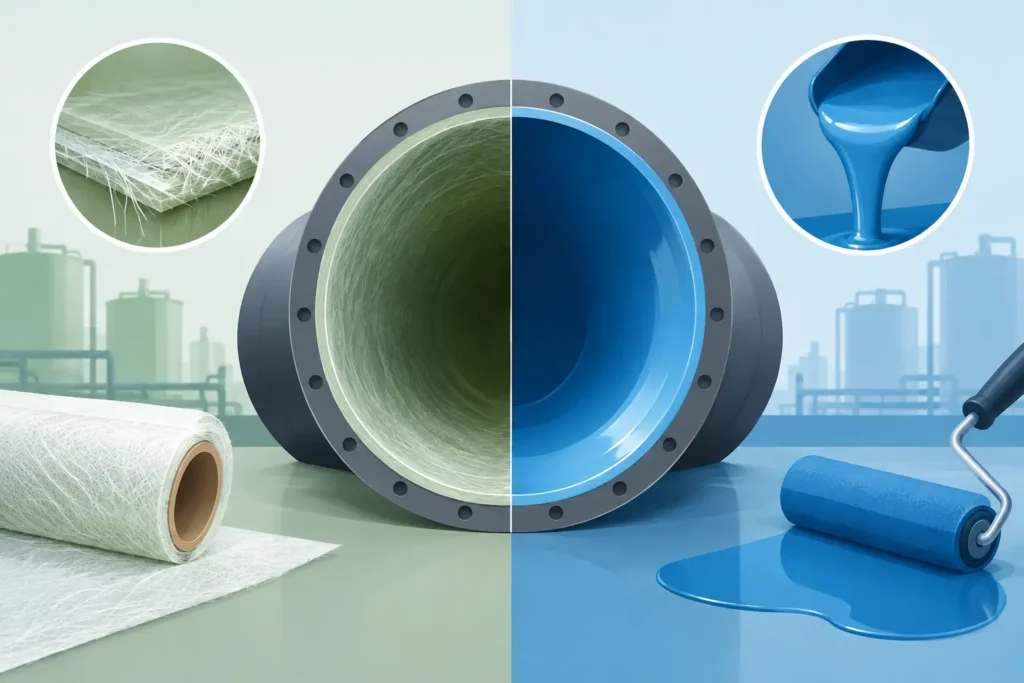
GRP stands for glass-reinforced plastic. It is a composite lining made by combining glass fiber reinforcement with a resin system. In waterproofing and renovation work, GRP is commonly installed in layers: resin, glass mat, additional resin, and a protective topcoat. The result is a thicker, reinforced membrane that can bridge small cracks, form continuous waterproofing over joints, and provide a durable finished surface.
Epoxy is a resin-based coating created by mixing epoxy resin with a hardener. Once cured, it forms a dense, strongly bonded protective layer. Epoxy systems are often applied as thin-film coatings, although high-build products can create a more substantial protective layer. They are widely used on concrete and steel where chemical resistance, abrasion resistance, and adhesion are the primary requirements.
There is one technical point that prevents confusion: GRP and epoxy are not always opposite materials. GRP can be manufactured using epoxy resin, although polyester and vinyl ester resins are also common in GRP lining applications. In practical property maintenance discussions, the comparison usually means a reinforced GRP lining versus an epoxy coating.
Where GRP lining is the stronger choice
GRP is generally selected when the surface needs more than a protective coat. Its glass fiber reinforcement gives it body and tensile strength, allowing it to handle minor substrate imperfections better than a standard coating system. It is particularly useful when waterproofing continuity is essential around corners, steps, drains, pipe penetrations, and changes in level.
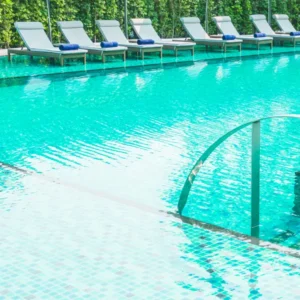
Swimming pools are a common example. A properly installed GRP lining can create a new waterproof internal shell over an existing pool structure. It is suitable for pool renovation where tiles have failed, grout joints are leaking, or the existing surface has become difficult to maintain. Because the lining is continuous, it removes many of the weak points associated with tiled surfaces and multiple grout joints.
GRP is also a practical option for water tanks, wet areas, roof details, decorative water features, and selected industrial containment applications. In these locations, the system can be shaped around irregular geometry and reinforced at vulnerable points. The finished surface can be smooth, cleanable, and suitable for long-term maintenance when the correct resin and topcoat are specified.
Its main trade-off is installation complexity. GRP work is not simply a matter of rolling material onto a surface. The substrate must be clean, dry, stable, and properly repaired. Laminating requires controlled mixing, correct overlap of glass mat, attention to air bubbles, and adequate curing between stages. Poor workmanship can lead to delamination, pinholes, uneven surfaces, or premature failure.
When epoxy is the better specification
Epoxy is often the more efficient choice when the substrate is sound and the goal is to protect rather than rebuild or bridge it. It bonds strongly to properly prepared concrete and steel, producing a hard surface that resists many chemicals, oils, cleaning agents, and abrasion.
For plant rooms, service corridors, workshops, parking areas, utility zones, and steel components, epoxy can provide a clean and durable protective finish. It is also used inside tanks and process areas where chemical exposure is known and the selected product is approved for that service. An epoxy floor coating can make cleaning easier while protecting concrete from dusting, stains, and surface wear.
Epoxy is normally thinner than a GRP lining, which can be an advantage where clearances, fittings, or existing details cannot accommodate added thickness. It can also be faster to apply on large, open, well-prepared surfaces. However, thinner does not mean less demanding. Epoxy depends heavily on surface preparation. Weak concrete, moisture vapor, dust, laitance, oil contamination, and poor profile preparation can all reduce adhesion.
Epoxy also has limits around movement and UV exposure. Standard epoxy coatings are hard and can crack if the substrate moves beyond their tolerance. Exterior applications may require a compatible UV-resistant topcoat because some epoxy products can chalk or discolor under direct sunlight. For exposed roofs and outdoor features, the full coating system matters more than the base material name.
Compare performance by the condition of the asset
The most useful question is not, “Which material is better?” It is, “What is failing, and what must the new system withstand?” A coating and lining specification should reflect the substrate, exposure conditions, desired finish, and access for future maintenance.
GRP is typically the stronger candidate when there are recurring leaks, hairline cracking, complex details, failed tile finishes, or a need for a reinforced waterproof membrane. It provides thickness and reinforcement that a conventional epoxy coating cannot replicate on its own.
Epoxy is usually the stronger candidate when concrete or steel is structurally sound but needs protection from chemicals, wear, moisture on the service side, or routine industrial cleaning. It provides excellent adhesion and a hard protective barrier without the added build-up of a fiberglass laminate.
For areas exposed to aggressive chemicals, resin selection is critical. A general-purpose polyester GRP system may not be appropriate for every chemical environment. Vinyl ester or specialist epoxy systems can offer better resistance in certain applications. The contractor should confirm the exact chemicals, concentrations, temperatures, cleaning methods, and exposure duration before recommending a system.
Surface preparation decides the service life
The quality of preparation often has more influence on performance than the material selected. Both GRP and epoxy can fail early when applied over damp, contaminated, unsound, or poorly repaired substrates.
Concrete should be inspected for cracks, hollow areas, loose render, failed tiles, and moisture-related issues. Defects should be repaired before coating or lining begins. Mechanical preparation may be needed to remove weak surface layers and create the correct profile for adhesion. Existing coatings must be tested, not assumed to be compatible.
Steel requires equally careful attention. Rust, mill scale, salts, and old failing paint need removal to the standard required by the selected product. Edges, welds, bolts, and corners may need stripe coating or additional reinforcement because they are common points of early breakdown.
Moisture deserves special attention in pools, tanks, basements, and wet rooms. If water pressure is coming from behind the substrate, applying a finish to the visible side may only hide the problem temporarily. A professional inspection should identify whether the issue is surface leakage, failed waterproofing, substrate cracking, plumbing leakage, or hydrostatic pressure.
Cost should include future maintenance
Epoxy may have a lower initial cost when a straightforward protective coating is sufficient. It uses less material, can be applied efficiently across open surfaces, and may require less labor than a multi-layer GRP laminate. For the right application, this makes it a cost-effective solution.
GRP generally involves a higher initial investment because it requires reinforcement materials, multiple stages of installation, and more detailed work around corners and penetrations. Yet it can offer better value where a reinforced waterproof lining prevents repeated repairs, pool closures, tile replacement, or water damage to surrounding areas.
Facility managers should compare whole-life cost rather than only the first quotation. Consider the expected service environment, downtime required for repair, cleaning requirements, appearance standards, and the cost of failure. Recoating a floor during planned maintenance is very different from repairing a leaking pool or tank after an operational disruption.
How to specify the right system
A dependable scope begins with a site survey. The contractor should assess the existing substrate, identify the cause of deterioration, check moisture conditions, and confirm how the area is used. The specification should state the preparation method, repair products, primer, lining or coating thickness, number of layers, topcoat, curing time, and testing requirements.
For pools and water-retaining structures, the scope should also address fittings, skimmers, drains, steps, expansion joints, and water testing after completion. For industrial floors or tanks, it should define chemical exposure and operational temperatures. These details prevent a generic coating from being used in a specialist environment.
Zillion Technical Services approaches GRP lining and epoxy works as part of the wider condition of the property, not as an isolated finish. That means checking related waterproofing, plumbing, surface damage, and maintenance needs before work begins, helping clients avoid repeated contractor coordination and avoidable rework.
The best choice is the one that addresses the actual failure mechanism and can be installed under the right site conditions. A careful inspection and a clear specification will do more for long-term performance than choosing GRP or epoxy by name alone.
