






A room that never cools properly, weak air from supply vents, and an AC system that runs for long periods are not minor comfort problems. In a home, office, retail unit, or managed property, they can increase energy use, strain equipment, and lead to occupant complaints. Knowing how to fix AC airflow issues starts with identifying where the restriction is occurring – at the filter, vents, ductwork, indoor unit, or the system controls.
Airflow problems are often treatable when addressed early. However, forcing a struggling system to keep running can turn a straightforward maintenance task into a blower, coil, refrigerant, or duct repair. The right approach is to complete safe visual checks first, then bring in qualified AC technicians when the issue involves internal equipment or concealed ductwork.
Start With the Most Common Airflow Restrictions
Before adjusting thermostat settings or assuming the AC unit has failed, inspect the accessible parts of the system. Many airflow issues come from basic restrictions that prevent conditioned air from moving freely through the property.
Check and replace the air filter
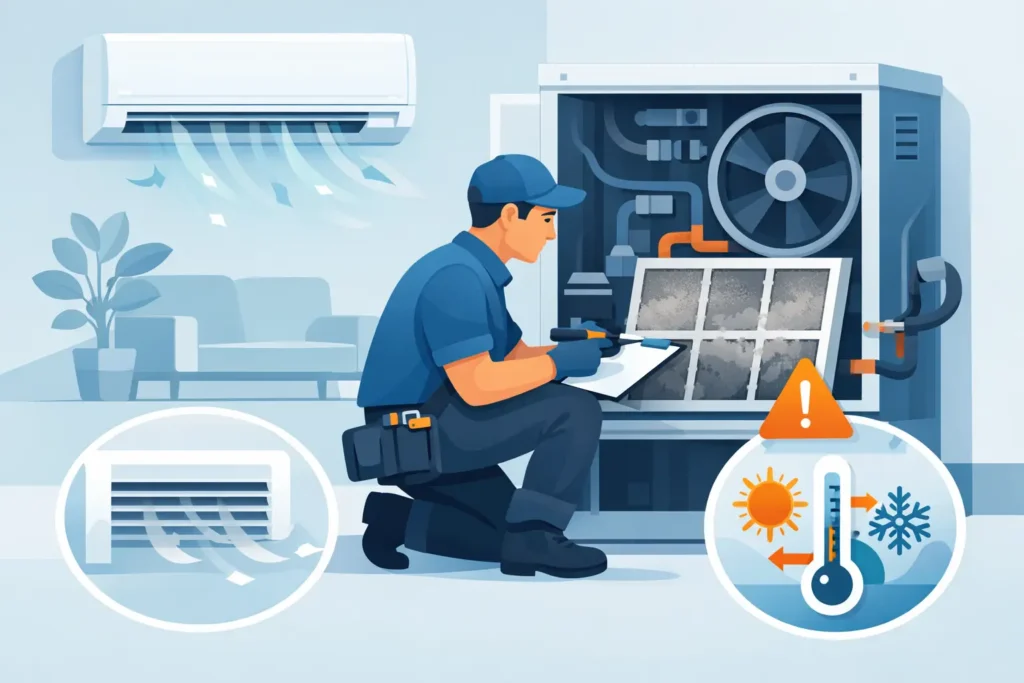
A clogged filter is one of the most common causes of weak AC airflow. It captures dust, fibers, and airborne particles, but eventually becomes dense enough to restrict the air entering the indoor unit. This makes the blower work harder while reducing the amount of cooled air reaching each room.
Turn off the system before removing the filter. If it looks gray, matted, or visibly coated with dust, replace it with the correct size and type. Do not select an overly dense filter simply because it appears more effective. High-efficiency filters can restrict airflow in systems not designed to handle them. Property owners should follow the manufacturer’s recommendation and replace filters on a regular schedule, especially in dusty environments or high-occupancy spaces.
Make sure vents and return grilles are open
Supply vents deliver cooled air into rooms, while return grilles pull indoor air back to the AC system for conditioning. Both must remain clear. Furniture, curtains, storage boxes, partitions, and even decorative covers can block circulation and create hot or stuffy zones.
Walk through the property and fully open supply vents unless an HVAC professional has specifically balanced the system differently. Avoid closing multiple vents to force more air into one room. This can raise pressure inside the duct system, reduce overall performance, and place unnecessary load on the blower. Return grilles need even more attention because a blocked return can affect airflow throughout the entire system.
Inspect the thermostat and operating mode
The thermostat does not create airflow, but incorrect settings can make an airflow concern appear worse. Confirm that the system is set to cooling mode and that the fan setting is appropriate. In many cases, the fan should remain on Auto so it runs when cooling is required rather than circulating untreated air continuously.
If airflow is weak from every vent, but the fan does not appear to run consistently, the fault may be related to the blower motor, capacitor, control board, or thermostat wiring. Those components should be inspected by a qualified technician rather than handled as a DIY repair.
How to Fix AC Airflow Issues Caused by Duct Problems
When the filter is clean and vents are open, uneven airflow often points to ductwork. Ducts distribute conditioned air, so leaks, loose connections, crushed sections, poor insulation, or accumulated debris can reduce delivery before air reaches the occupied space.
A clear sign of a duct issue is a noticeable difference between rooms. One area may receive strong cooling while another remains warm, even with vents open and no obvious obstructions. You may also hear whistling near vents, rattling above ceilings, or feel air escaping from accessible duct joints.
Accessible ducts can be visually checked for disconnected sections, damaged insulation, or loose tape. Do not rely on standard cloth-backed duct tape as a long-term repair. HVAC-rated sealing materials and proper mechanical connections are required for a durable result. Concealed ducts, particularly those above false ceilings or inside walls, require professional inspection to avoid damage to finishes and to locate leaks accurately.
Duct cleaning can help when there is confirmed buildup affecting air movement, but it is not a cure for every AC complaint. If the real problem is a failing blower, undersized ducts, or poor balancing, cleaning alone will not restore performance. A technician should assess the complete air distribution system before recommending work.
Check the Indoor and Outdoor Units
Airflow is closely connected to how well the AC system can transfer heat. A dirty indoor evaporator coil can restrict air passing through the unit and may eventually freeze. Ice on refrigerant lines, water around the indoor unit, or a sudden drop in airflow are warning signs that require prompt attention.
Do not continue operating a system with a frozen coil. Turn cooling off, set the fan to Off if instructed by your service provider, and allow the equipment to thaw. The cause could be a dirty filter, blocked coil, low refrigerant, blower fault, or drainage issue. Adding refrigerant without identifying and repairing a leak is not a proper solution.
The outdoor condenser also needs clear space around it to reject heat effectively. Remove leaves, loose debris, and stored items from the surrounding area. Avoid spraying electrical components with water or attempting to disassemble the unit. Dirty outdoor coils, damaged fan blades, and electrical faults should be handled during professional AC servicing.
Look for Clues in the Pattern of the Problem
The location and timing of weak airflow can help narrow the cause. If one room has poor airflow all the time, look first at its vent, branch duct, damper, or room layout. If the entire property has weak airflow, the filter, return path, indoor coil, or blower assembly may be responsible.
Airflow that drops after the system runs for an hour may indicate coil icing or an overheating blower motor. Air that is strong but not cold points to a different category of issue, such as refrigerant performance, compressor operation, or thermostat control. These distinctions matter because the wrong repair can waste time and money.
For commercial properties, airflow concerns can also result from changes made after installation. New partitions, fit-outs, added equipment, altered occupancy, or renovated rooms can change cooling loads and block designed air paths. A system that was adequate for an open office may need balancing or duct modifications after the layout changes.
When to Call a Professional AC Technician
Basic filter replacement and vent clearance are reasonable maintenance tasks. Beyond that, AC airflow diagnosis often requires electrical testing, pressure checks, airflow measurement, coil cleaning, duct inspection, and system balancing. Calling a professional early is the practical choice when symptoms suggest an internal fault.
Arrange service if you notice any of the following:
- Weak airflow continues after replacing the filter and clearing vents.
- Airflow is significantly different between rooms or floors.
- The unit makes grinding, buzzing, or persistent rattling sounds.
- Ice forms on pipes, coils, or the indoor unit.
- Water leaks from the AC unit or ceiling area.
- The system trips breakers, shuts down unexpectedly, or runs without cooling.
A qualified technician can measure static pressure, inspect the blower, clean coils safely, test capacitors and controls, and check ducts for leakage or imbalance. For landlords, facility managers, and commercial operators, a documented inspection also helps prioritize repairs and plan preventive maintenance rather than responding only after a breakdown.
Prevent Airflow Issues With Scheduled Maintenance
In hot climates and heavily used properties, AC maintenance is not just about comfort. It protects equipment runtime, energy performance, and indoor conditions. A preventive service plan should include filter checks, coil cleaning when needed, condensate drain inspection, electrical testing, blower assessment, and a review of airflow at key supply and return points.
The right frequency depends on operating hours, dust exposure, occupancy, pets, nearby construction, and the type of property. A lightly used residence may have different needs than a restaurant, office, retail space, or multi-unit building. Maintenance should be based on actual conditions rather than a one-size-fits-all schedule.
Zillion Technical Services LLC supports property owners and facility teams with AC servicing, duct-related work, and broader technical maintenance under one dependable service partner. Addressing airflow concerns promptly helps protect occupant comfort while reducing the risk of avoidable equipment damage.
If your AC is moving less air than it should, begin with the filter, vents, and return grilles today. If those checks do not restore normal performance, a professional inspection can identify the real restriction before a minor airflow issue becomes a costly interruption.
