








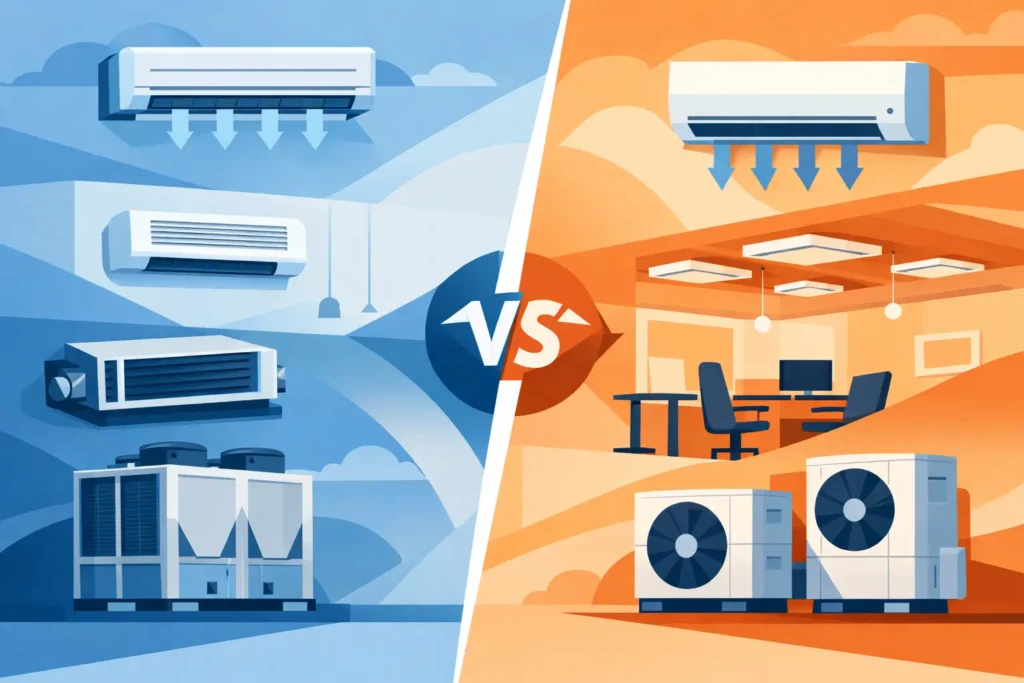
A hotel room that is too cold, an office meeting room that never cools down, and utility bills that rise every summer often point to the same decision: fan coil versus VRF. Both systems can provide dependable comfort in Dubai properties, but they distribute cooling differently, require different infrastructure, and create very different maintenance responsibilities.
For property owners and facility managers, the right choice is rarely about selecting the most advanced system on paper. It is about matching the HVAC design to the building’s size, occupancy pattern, renovation constraints, and long-term operating plan.
Fan Coil Versus VRF: The Core Difference
A fan coil unit, commonly called an FCU, cools a room by moving air across a chilled-water coil. The chilled water is supplied by a central chiller or another chilled-water source, while the fan coil is installed within or near the conditioned space. Fan coils are common in apartments, hotels, offices, and larger buildings with centralized chilled-water networks.
A VRF system, short for variable refrigerant flow, circulates refrigerant directly between an outdoor condensing unit and multiple indoor units. It adjusts refrigerant flow according to the cooling demand in each zone. This gives occupants and operators more individual control than many traditional centralized arrangements.
The distinction matters during installation and service. Fan coil systems depend on water piping, drainage, valves, pumps, insulation, and the central chilled-water plant. VRF systems depend on refrigerant piping, branch selectors where required, electronic controls, communication wiring, and correctly commissioned outdoor units. Neither approach is maintenance-free, and both require qualified technicians.
When Fan Coil Systems Make Sense
Fan coils remain a practical choice for properties already served by a chiller. In a multi-story tower, hotel, or community building with chilled water available, replacing or upgrading fan coil units may be more economical than converting the property to an entirely different system.
They can also suit projects where central plant maintenance is managed at the building level. Individual apartments or offices receive cooling through their own fan coils, while the chiller plant, pumps, and main water network are handled centrally. This arrangement can simplify the tenant-side equipment while giving building management control over the primary cooling infrastructure.
Fan coils are available in concealed ducted, cassette, wall-mounted, and floor-mounted configurations. A concealed ducted unit can preserve interior aesthetics and serve more than one small area through short duct runs. However, access panels must be planned properly. A hidden fan coil with no service access will eventually become an expensive ceiling repair.
The trade-off is that a fan coil’s performance relies on more than the unit itself. Dirty strainers, faulty control valves, blocked condensate drains, poor water balancing, and inadequate chilled-water temperature can all reduce cooling. In shared buildings, an occupant may report that the AC is weak even though the fan coil is operational, because the issue lies in the central supply.
Where VRF Delivers Strong Value
VRF is often well suited to villas, retail units, standalone offices, clinics, restaurants, and renovation projects where independent temperature control is a priority. Each indoor unit or zone can respond to its own thermostat, allowing a lightly occupied area to use less cooling than a busy one.
This zoning can reduce wasted energy. A villa does not need to cool every bedroom at the same level during the day. An office may need strong cooling in a server room and meeting area while keeping empty workstations at a higher setpoint. VRF systems are designed to modulate capacity rather than repeatedly operating at full output.
Installation can also be more flexible than extending chilled-water piping to a building without an existing central network. Refrigerant lines are generally smaller than chilled-water pipes, which may help during interior fit-outs where ceiling space and routing options are limited. That said, “easier to install” does not mean simple. Pipe sizing, line lengths, elevation differences, refrigerant charge, pressure testing, evacuation, and controls commissioning must be correct from the start.
VRF has limitations that should be considered before specifying it. Initial equipment and installation costs can be higher than basic split AC solutions. Refrigerant leak detection, ventilation requirements, and safety compliance need careful assessment, particularly in small enclosed rooms. Repairs can also require brand-specific diagnostic tools and technicians trained on the system’s controls.
Comparing Cost Beyond the Initial Quote
The lowest installation quote is not always the lowest cost of ownership. Fan coil and VRF projects should be evaluated through capital cost, energy use, expected maintenance, replacement planning, and downtime risk.
For a building with an operational chiller network, installing fan coils may be the logical financial choice because major infrastructure already exists. The project cost may focus on unit replacement, valves, thermostats, duct modifications, insulation repairs, and drain connections. Replacing a failed fan coil is also often less disruptive than replacing a large outdoor VRF module, depending on access.
For a villa or a commercial unit without chilled water, VRF can avoid the cost and complexity of installing a chiller, pumps, water treatment equipment, and extensive water piping. Its higher efficiency at part load can be valuable when spaces are occupied irregularly. Actual savings, however, depend on thermostat settings, building insulation, solar gain, occupant behavior, equipment selection, and maintenance quality.
A useful comparison should include the electrical load, capacity calculations, number of zones, access needs, and projected hours of use. It should also identify what is excluded. Controls, condensate drainage, ductwork, fresh-air provision, electrical upgrades, civil works, and ceiling restoration can significantly affect the final project budget.
Maintenance Needs in Dubai’s Climate
Dubai’s heat, humidity, dust, and long cooling season place constant pressure on HVAC equipment. Whether a property uses fan coils or VRF, preventive maintenance is essential to protect comfort, indoor air quality, and equipment life.
Fan coil servicing typically includes cleaning filters and coils, checking blower motors, inspecting and flushing drain lines, testing thermostats, verifying valve operation, and checking for water leaks or insulation damage. If the building has a chilled-water system, pump operation, water quality, strainers, balancing, and chiller-side performance also need scheduled attention.
VRF maintenance includes cleaning filters and indoor coils, clearing drains, inspecting electrical terminals, checking communication faults, reviewing operating pressures and temperatures, cleaning outdoor coils, and confirming refrigerant circuit integrity. Outdoor units need particular attention in dusty locations, where blocked condenser coils can drive up energy consumption and reduce capacity.
For both systems, neglected condensate drains can lead to ceiling damage, odors, microbial growth, and tenant complaints. Maintenance teams should not wait for a leak before cleaning drains. A planned AC maintenance schedule is more cost-effective than emergency callouts during peak summer conditions.
Design Questions to Ask Before Choosing
The best HVAC selection begins with a site assessment, not a preference for a particular technology. Start with the building type and the cooling source already available. An apartment in a chilled-water tower has different options from a standalone villa or a newly fitted retail space.
Consider how occupants use each room. If every zone follows the same operating schedule, a fan coil arrangement supplied by central chilled water may be efficient and straightforward. If room-by-room control and varying occupancy are central to operations, VRF may provide a stronger fit.
Also assess future service access. Technicians need room to remove filters, clean coils, inspect valves or refrigerant connections, and repair drains without damaging finished interiors. This is especially important during renovations, when attractive ceilings and joinery can accidentally make essential equipment inaccessible.
Finally, confirm the required fresh-air strategy. Fan coils and many VRF indoor units primarily recirculate indoor air. They do not replace properly designed ventilation. Offices, restaurants, clinics, and high-occupancy spaces may require dedicated fresh-air equipment to meet comfort and operational requirements.
A Practical Choice for Property Operations
Fan coil systems are often the right answer when chilled water is already available, central plant management is reliable, and the property needs a proven room-level cooling solution. VRF is often compelling where independent zoning, flexible installation, and part-load efficiency can improve comfort and operating control.
The equipment choice should support the wider condition of the property, including electrical capacity, drainage, ceilings, insulation, controls, and planned maintenance. Zillion Technical Services LLC can assess these connected requirements as part of a practical HVAC installation, repair, or maintenance scope.
Before committing to either system, request a site-specific load calculation and an access-focused installation plan. The system that keeps occupants comfortable is the one that is correctly sized, professionally installed, and consistently maintained long after handover.
