






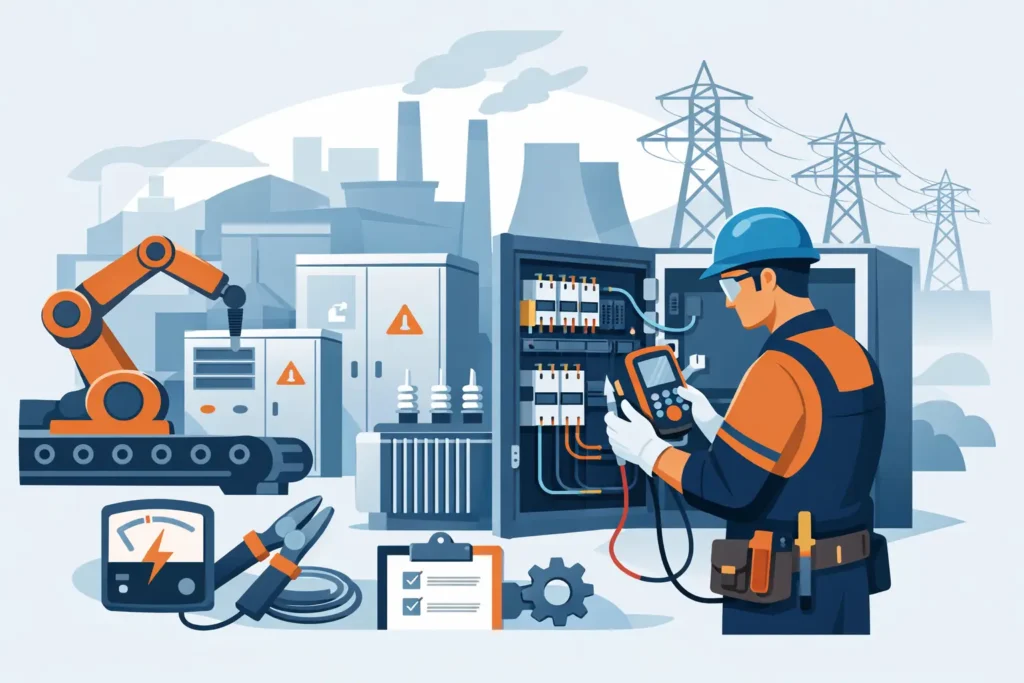
An unexpected trip in a production panel rarely starts at the moment equipment stops. Loose terminations, heat buildup, moisture entry, overloaded circuits, and declining insulation can develop quietly for months. A practical industrial electrical maintenance guide gives facility teams a structured way to identify these issues before they become costly downtime, safety incidents, or damage to critical assets.
For industrial sites, electrical maintenance is not limited to replacing a failed breaker or resetting a motor starter. It is an ongoing program that protects people, preserves equipment life, supports production continuity, and helps managers plan work instead of reacting to emergencies.
Start With a Complete Electrical Asset Register
Effective maintenance begins with knowing what is installed, where it is located, and how essential it is to operations. Create an asset register for main switchgear, distribution boards, transformers, motor control centers, generators, UPS systems, capacitor banks, cable routes, lighting controls, emergency systems, motors, pumps, and associated control panels.
Each asset record should include the manufacturer, model, rating, installation date, service history, test results, protection settings, and available drawings. Labeling must match the single-line diagram and the actual field installation. When a technician cannot confidently identify the upstream isolator, feeder, or load served by a panel, a simple repair can become a prolonged and unsafe shutdown.
Criticality should also be recorded. A panel serving a nonessential storage area does not require the same maintenance priority as a board feeding production machinery, chilled water pumps, fire-life-safety systems, or data equipment. This ranking helps facility managers allocate labor, spares, and shutdown windows where they create the greatest operational value.
Build a Risk-Based Maintenance Schedule
A calendar-only approach is often too basic for industrial electrical work. Equipment operating in a clean, air-conditioned electrical room may need a different inspection interval than equipment exposed to dust, humidity, vibration, chemical vapors, or high ambient temperatures.
Use a risk-based schedule that considers equipment age, duty cycle, load profile, environment, failure history, and operational consequence. Visual checks may be scheduled monthly or quarterly, while detailed internal inspections, testing, and cleaning may be annual or based on manufacturer recommendations and site conditions.
Routine Visual and Operational Checks
Routine inspections can identify early warning signs without intrusive work. Qualified personnel should look for damaged enclosures, missing blanks, corroded components, blocked ventilation, water stains, unusual noise, burnt odors, nuisance tripping, and signs of overheating around breakers, cable glands, busbars, and terminals.
Technicians should also confirm that electrical rooms remain accessible and clean. Storage in front of panels, poor housekeeping, water leaks, and unauthorized modifications are common risks that can compromise maintenance access and equipment reliability.
Planned Shutdown Inspections
Some defects cannot be confirmed while equipment is energized. During a controlled shutdown, trained electrical personnel can inspect internal connections, contact wear, insulation condition, busbar supports, earth connections, mechanical interlocks, and breaker mechanisms.
This work must be planned around operational needs. Shutting down a critical production line may require temporary power arrangements, advance coordination with operations, and a defined return-to-service procedure. The goal is not to create unnecessary outages, but to use planned downtime to prevent longer unplanned failures.
Control Heat, Load, and Power Quality
Heat is one of the clearest indicators of electrical deterioration. Excess resistance at a loose connection can generate heat long before a circuit fails. Overloaded conductors, poor ventilation, unbalanced loads, and aging components can produce similar conditions.
Infrared thermography is valuable because it allows technicians to inspect energized equipment from a safe distance when performed by competent personnel under an approved safety process. Thermal scans can reveal hot terminals, overloaded phases, failing breakers, weak fuse connections, and abnormal transformer temperatures. A thermal image is not a final diagnosis, however. The maintenance team must investigate the cause, correct it during a safe work window, and document the repair.
Load monitoring should be part of the same process. Measure current on each phase, compare it with equipment ratings, and investigate imbalance. Persistent phase imbalance can increase motor temperature, reduce efficiency, and shorten equipment life. In facilities with variable-speed drives, sensitive electronics, or large nonlinear loads, power quality testing may also be necessary to identify harmonics, voltage fluctuation, and poor power factor.
Corrective action depends on the findings. It may involve redistributing loads, upgrading conductors, improving ventilation, tightening connections to specified torque values, or reviewing the capacity of transformers and panels. Adding equipment without reviewing the existing electrical infrastructure is a frequent cause of avoidable stress on a system.
Protect People With Electrical Safety Procedures
Industrial electrical maintenance must be led by safety, not speed. Only qualified and authorized personnel should perform electrical testing, isolation, repairs, or energized diagnostic work. Site procedures should address lockout/tagout, verification of absence of voltage, arc-flash risk, appropriate personal protective equipment, and emergency response.
A lockout procedure is more than placing a tag on an isolator. The worker must identify every possible energy source, isolate it, apply personal locks, release or restrain stored energy, verify de-energization with properly rated test equipment, and confirm the circuit is safe before work begins. Complex systems may have generator backfeed, UPS supply, photovoltaic connections, control transformers, or interlocked equipment that must be included in the isolation plan.
Electrical room access should be controlled, and current single-line diagrams should be available to authorized personnel. Arc-flash labels, where applicable, need to be legible and based on current system information. If the system has been modified, protective device settings and studies may need review. A label from an old configuration should not be treated as permanent proof of risk level.
Maintain the Equipment That Supports the Electrical System
Electrical reliability is closely connected to mechanical and building conditions. A panel enclosure exposed to condensate from an AC unit, airborne dust from construction work, or water ingress from a roof leak will not perform as intended. Likewise, failed ventilation in a switch room can raise ambient temperatures and accelerate component aging.
Coordinate electrical maintenance with HVAC servicing, waterproofing, cleaning, civil repairs, and general facility upkeep. Check room temperature, ventilation paths, door seals, cable trench condition, drainage, and enclosure protection ratings. In humid or dusty industrial environments, cleaning frequency and inspection intervals may need to increase.
Backup power systems also require coordinated maintenance. Generators, automatic transfer switches, batteries, UPS units, fuel systems, and emergency lighting should be tested as a system, not as isolated assets. A generator that starts correctly is of limited use if the transfer switch fails to operate or a downstream breaker does not close.
Use Testing to Make Decisions, Not Just Fill Reports
Maintenance reports should give facility managers a clear view of condition, risk, and required action. Useful records include insulation resistance readings, earth continuity results, breaker test data, thermal images, battery test results, load measurements, torque records, and protection relay settings.
Trend data is more valuable than a single result. A motor with insulation resistance that remains acceptable but declines steadily over several test cycles may require attention before it reaches a failure point. The same principle applies to battery capacity, transformer temperature, and recurring thermal anomalies.
Every finding should be assigned a priority. Immediate hazards require isolation or urgent correction. High-priority defects should receive a planned repair date and operational coordination. Lower-risk improvements can be grouped into a budgeted maintenance scope. This approach prevents reports from becoming a list of observations with no accountable follow-through.
Keep Critical Spares and Response Plans Ready
The correct spare parts depend on the facility, but critical operations commonly need selected breakers, fuses, contactors, overload relays, control power components, indicator lamps, cable glands, terminal blocks, and batteries available or obtainable quickly. Spare selection should be based on lead time, failure likelihood, and production impact, not on storing every component used on site.
Document the response process for an electrical failure before it occurs. Define who can authorize shutdowns, who contacts the maintenance contractor, which drawings and access permissions are required, and how production teams will be informed. After any major trip or fault, investigate the root cause rather than simply restoring power. Repeated resets can turn a manageable defect into damaged equipment or a serious safety event.
For facilities managing several technical disciplines, a coordinated maintenance partner can reduce delays between electrical troubleshooting, cooling repairs, water-ingress correction, and general building works. Zillion Technical Services supports this one-stop approach with planned technical maintenance and responsive site support tailored to operational requirements.
A dependable electrical system is built through disciplined inspection, accurate records, qualified work practices, and timely corrective action. The most valuable maintenance visit is often the one that finds a small defect early, schedules the right repair, and allows the facility to keep operating without disruption.
