



A pool that needs frequent topping up is not always leaking. Heat, sun exposure, wind, splashing, and backwashing can all reduce the water level. But when the loss becomes consistent, or when surrounding surfaces stay damp, pool leaks should be treated as a property maintenance priority. Delayed repairs can increase water bills, affect chemical balance, damage finishes, and, in more serious cases, compromise surrounding structures.
For homeowners, landlords, and facility managers, the practical goal is not simply to stop the visible water loss. It is to identify the source accurately, repair the right component, and prevent a recurring issue from disrupting the pool’s condition and availability.
When Water Loss Is More Than Evaporation
Evaporation is normal, especially in warm climates or on pools with long daily sun exposure. The amount varies with temperature, humidity, wind, water temperature, and whether the pool is covered. A heated pool or an infinity-edge pool may also lose more water than a standard residential pool.
A useful first check is the bucket test. Fill a bucket with pool water and place it on a pool step so the water inside the bucket is at the same level as the pool water outside it. Mark both levels, then leave the pool pump off for 24 hours. If the pool water drops more than the bucket water, a leak is likely. Repeat the test with the pump running. A greater loss while equipment is operating can point toward the circulation system, while loss in both tests may indicate a shell, fitting, or plumbing issue.
This test does not locate the fault, but it helps avoid unnecessary work caused by mistaking normal evaporation for a leak. It is also valuable for facility teams that need clear records before approving repairs.
Common Signs of Pool Leaks
Water loss is the obvious indicator, but it is rarely the only one. A pool leak often creates secondary signs that appear before the water level becomes alarming. Watch for wet or soft ground around the pool, loose tiles, cracks that are widening, staining around fittings, or a water level that repeatedly stops at the same point.
Chemical consumption can also be a clue. When fresh water is constantly added, sanitizer and balancing chemicals are diluted. Operators may find themselves using more chemicals than usual while still struggling to maintain stable readings. This can affect water clarity, bather comfort, and equipment performance.
Equipment behavior matters as well. Air entering the suction side of the circulation system may cause bubbles at the return jets, reduced pump pressure, noisy operation, or difficulty maintaining prime. A leak on the pressure side may be less visible, but can leave damp areas near pumps, filters, valves, or underground pipe routes.
A sudden increase in make-up water use should always be investigated. Water is not the only cost. The pool may require extra heating, chemical treatment, and filtration time to restore proper operating conditions.
Where Pool Leaks Usually Begin
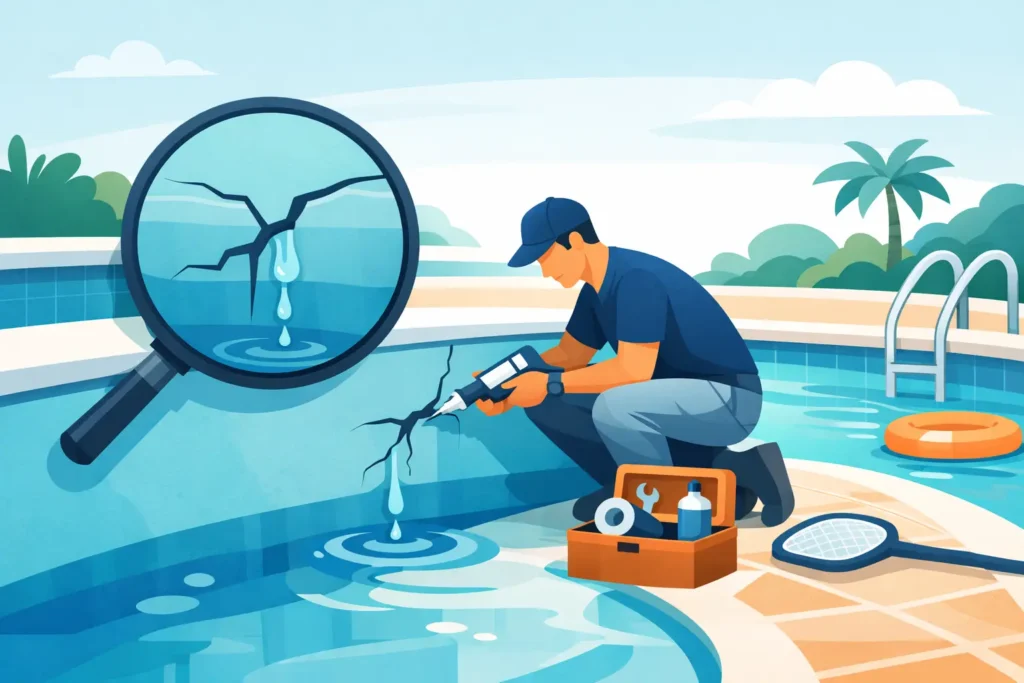
Leaks can occur in the pool structure, plumbing system, fittings, or equipment. The repair approach depends entirely on the source, which is why a proper inspection is more reliable than applying sealant to the first visible crack.
Pool shell and finish defects
Concrete pools can develop cracks from settlement, thermal movement, aging, or structural stress. Not every crack leaks, and not every leak comes from a visible crack. A fine surface crack in plaster may be cosmetic, while a crack that extends through the waterproofing layer can allow water to migrate behind the finish.
Tile joints, coping joints, skimmer throats, expansion joints, and the connection between different materials are common weak points. Movement around these areas can break down grout, sealant, or waterproofing over time. In a lined pool, tears, failed seams, and damage around penetrations may create the same problem.
Fittings and penetrations
Lights, return inlets, main drains, skimmers, vacuum ports, and handrail anchors all pass through the pool shell. Each penetration requires a watertight connection. Aging gaskets, cracked housings, failed sealant, or loose fittings can allow water to escape behind the pool finish.
Leaks around light niches deserve careful attention. Electrical components must be isolated and inspected by qualified technicians before any repair work begins. This is not an area for trial-and-error patching.
Plumbing and equipment faults
Underground circulation pipes can crack, separate at joints, or be damaged by ground movement. Valves, pump seals, filter connections, heater unions, and chlorinator lines can also leak. Equipment-room leaks are often easier to see, but small drips should not be ignored. They can cause corrosion, create slip hazards, and shorten the life of nearby electrical and mechanical components.
The pattern of water loss offers useful direction. If the pool loses more water with the pump running, pressure-side lines, return fittings, or equipment may be involved. If loss increases with the pump off, suction lines or the pool shell may be more likely causes. These are indicators, not final diagnoses. Professional testing is still needed before excavation or major repairs are approved.
A Reliable Process for Finding a Leak
Accurate leak detection protects the property owner from unnecessary demolition and repeat repairs. The process should begin with a visual assessment of the pool, deck, equipment pad, visible plumbing, fittings, and finish condition. Technicians should also review water-loss history, maintenance records, recent renovation work, and any changes in pump performance.
The next stage may include pressure testing plumbing lines, isolating individual circuits, dye testing around suspected fittings and cracks, and inspecting the structure at the waterline. Specialized listening equipment, cameras, or tracer methods may be used when the source is hidden. The right method depends on the pool type, its plumbing layout, access conditions, and the evidence found during inspection.
A credible repair recommendation should explain what was tested, what was found, and why the proposed repair addresses the actual failure point. For commercial properties, this documentation is particularly useful for maintenance planning, budget approvals, and future warranty discussions.
Repair Options Depend on the Cause
Minor leaks around fittings may be resolved by replacing gaskets, resealing penetrations, repairing grout and expansion joints, or renewing deteriorated sealant. These repairs can be effective when the surrounding structure and waterproofing remain sound.
Cracked finishes may require localized crack treatment and resurfacing. If the pool has widespread hollow areas, tile failure, recurring cracks, or deteriorated waterproofing, a broader renovation may be the better long-term decision. A temporary patch can reduce immediate water loss, but it may not solve movement or waterproofing failure beneath the surface.
Plumbing repairs range from replacing accessible valves and unions to repairing or rerouting damaged underground lines. Excavation is sometimes necessary, but it should be based on test results rather than assumption. In some cases, a targeted route or pipe replacement is less disruptive than repeatedly opening deck areas in search of a fault.
For pools with aging finishes and multiple repair points, combining leak repairs with renovation work can reduce repeat disruption. Waterproofing, tile replacement, coping repairs, lighting upgrades, and equipment improvements are easier to coordinate when the pool is already out of service. The trade-off is a higher initial project cost, but the result may be a more durable and consistent pool system.
Preventing Repeat Leak Problems
Regular maintenance is the strongest defense against avoidable water loss. Pool operators should monitor water level, chemical consumption, pump pressure, and equipment-room conditions as part of routine checks. Any unexplained change should be recorded and assessed early.
Joint sealant, grout, tile edges, skimmer connections, and visible plumbing should be inspected before small defects become larger repairs. Maintaining balanced water chemistry also protects finishes, metal components, seals, and equipment. Water that is consistently aggressive or poorly balanced can accelerate deterioration across the pool system.
For properties with heavy pool use, an annual maintenance contract provides a more controlled approach. Scheduled inspections help identify issues before they cause downtime, while one technical partner can coordinate pool care with waterproofing, tile, plumbing, electrical, and general maintenance work. Zillion Technical Services supports this approach with qualified pool maintenance and renovation services designed around dependable property performance.
A leaking pool rarely improves on its own. Acting when the first signs appear gives owners and managers more repair options, lower disruption, and a better chance of preserving the pool as a safe, clean, and reliable amenity.
