




A roof leak rarely starts as a dramatic ceiling stain. In many properties, it begins with hairline cracks around a drain, failed sealant at a pipe penetration, or water sitting on a flat roof after a storm. Choosing the best waterproofing methods for rooftops means looking beyond a quick patch and selecting a system that suits the roof structure, surface condition, drainage, and exposure to heat.
For property owners and facility managers, the right solution protects more than the roof slab. It helps prevent damaged ceilings, corroded MEP components, mold growth, interrupted operations, and costly interior repairs. In hot climates with intense sun, dust, sudden rainfall, and high rooftop temperatures, workmanship and surface preparation matter as much as the waterproofing material itself.
Why rooftop waterproofing failures happen
Waterproofing systems fail when water finds a weak point and remains there long enough to penetrate the assembly. The visible leak may appear meters away from the actual defect because water can travel beneath tiles, screeds, insulation, or an existing membrane before entering the building.
Common causes include aging coatings, movement cracks in concrete, poor slope toward drains, damaged flashing, unsealed service penetrations, and repairs made with incompatible products. Flat roofs are particularly vulnerable when debris blocks drainage outlets and creates standing water. A system may look acceptable from a distance while its seams, corners, and upturns are already compromised.
A proper inspection should identify the roof construction, existing waterproofing layer, moisture condition, drainage performance, and all detailing points. Applying a new coating over trapped moisture, loose material, or an unstable old membrane can delay failure, but it will not solve the underlying issue.
Best waterproofing methods for rooftops
There is no single best material for every building. A small residential concrete roof, a commercial roof with frequent maintenance traffic, and a tiled podium deck each require different levels of flexibility, thickness, protection, and repairability. The following methods are widely used when selected and installed correctly.
Liquid-applied polyurethane waterproofing
Polyurethane systems form a continuous, elastic membrane over the roof surface. Because they are liquid-applied, they can conform well to complex areas around pipes, drains, parapet walls, AC supports, and irregular roof details. Once cured, the membrane creates a joint-free barrier that can accommodate moderate building movement.
This method is often a strong option for concrete roofs with many penetrations or difficult shapes. It can also be used as part of a repair strategy where localized details need extra protection. However, polyurethane requires disciplined surface preparation. The substrate must be clean, dry, sound, and properly primed. Incorrect mixing, poor thickness control, or application during unsuitable weather can cause blistering, weak adhesion, or early breakdown.
For exposed roofs, a UV-resistant topcoat may be required. This protects the membrane from sun exposure and can improve reflectivity, helping reduce heat absorbed by the roof surface.
Acrylic waterproof coatings
Acrylic coatings are water-based, practical for many exposed concrete roofs, and commonly chosen for their flexibility and reflective finish. They can help protect a roof from rainwater and ultraviolet exposure while reducing surface temperature when a light-colored coating is used.
They are generally most suitable for roofs with good drainage. Acrylic coatings are not the preferred choice where standing water remains for extended periods, as continuous ponding can reduce performance over time. They also depend on correct film thickness, reinforcement at cracks and joints, and adequate curing between coats.
For a roof with minor surface cracking and no major structural or drainage issue, an acrylic system can provide efficient protection. If the roof has persistent ponding, deep cracks, or failed substrate areas, drainage corrections and more heavy-duty waterproofing should be considered first.
Bituminous membrane systems
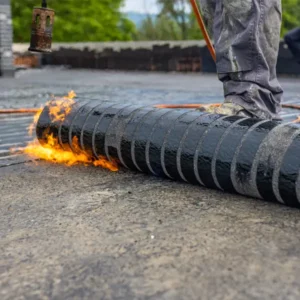
Torch-applied or self-adhesive bituminous membranes remain a dependable waterproofing choice for many flat concrete roofs. These systems use pre-manufactured rolls with controlled thickness and are installed with overlapping seams to form a durable barrier. Modified bitumen membranes can provide good resistance to water and mechanical wear, especially when protected by screed, tiles, pavers, or a suitable coating.
Bituminous membranes are well suited to large roof areas and podium slabs where a proven layered system is needed. They are also commonly used below protective finishes. Their main risk lies in workmanship at seams, corners, parapets, and penetrations. Incomplete heat welding or poor lap alignment can create concealed leak paths.
A torch-applied system must be installed by trained technicians using controlled safety procedures. Fire risk, substrate compatibility, and ventilation around service areas need careful consideration. For occupied buildings, self-adhesive alternatives may be preferable in certain locations, although they still require a properly prepared and primed surface.
Cementitious waterproofing
Cementitious waterproofing is a cement-based coating system often used on concrete and masonry substrates. It is especially useful for water tanks, bathrooms, planter boxes, retaining walls, and some protected roof areas. It bonds well to sound concrete and can be applied to damp surfaces more easily than several resin-based systems.
On an exposed rooftop, standard rigid cementitious coatings are less suitable where thermal movement and cracking are expected. Flexible cementitious systems perform better, but they still need proper crack treatment and protection from movement beyond their limits. This method works best when the roof assembly will be covered with screed, tile, pavers, or another protective layer rather than left fully exposed to weather.
PVC, TPO, and EPDM sheet membranes
Single-ply membranes such as PVC, TPO, and EPDM are designed for broad roof coverage and can be excellent choices for commercial buildings. They are installed in large sheets, with seams welded or bonded according to the material. Their light-colored surfaces can provide strong UV resistance and solar reflectivity, making them attractive for roofs exposed to high heat.
PVC and TPO membranes are commonly heat-welded at the seams, while EPDM is typically bonded or taped. The right selection depends on the roof design, chemical exposure, expected foot traffic, and local installation expertise. These systems require careful detailing at drains, parapets, curbs, and equipment supports. A high-quality membrane can still fail if the edge terminations or penetrations are not properly secured.
Single-ply systems are often practical for large, accessible roofs where future maintenance inspections are expected. They should be protected from sharp objects and uncontrolled contractor traffic during AC, ducting, solar, or other rooftop works.
Roof details matter more than the main surface
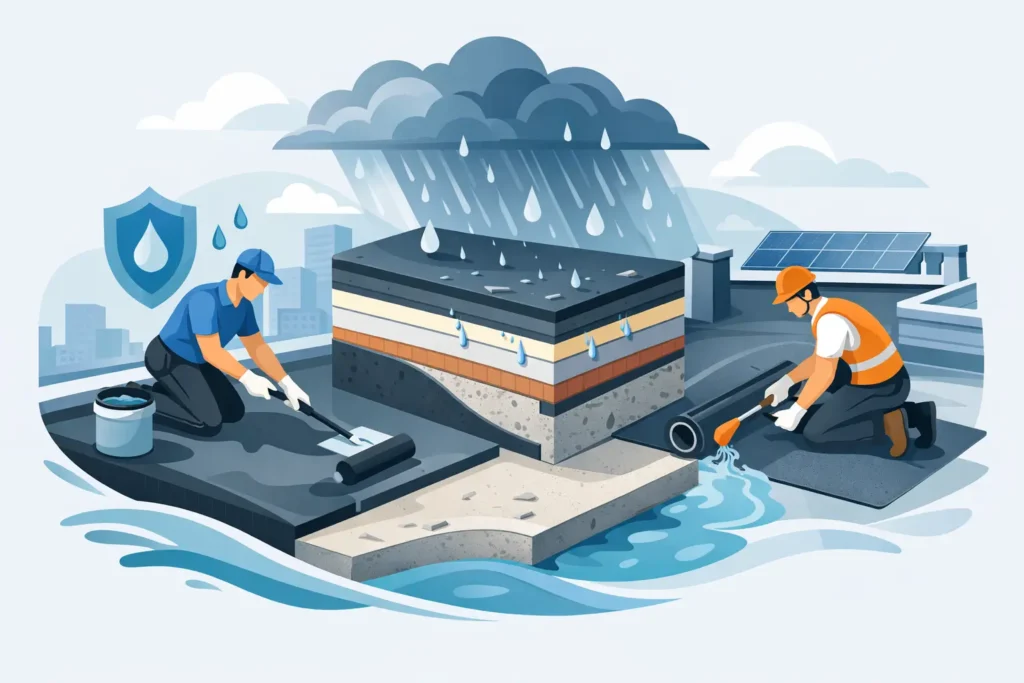
Most leaks occur at transitions, not in the middle of an open roof area. Drains, expansion joints, parapet upturns, pipe sleeves, metal flashing, and AC equipment bases need reinforced treatment. Waterproofing should turn up vertical surfaces to a suitable height and terminate securely so wind-driven rain cannot enter behind the membrane.
Drainage deserves equal attention. If water remains on the roof for more than a short period after rainfall, the issue may be inadequate slope, blocked drains, or insufficient drainage points. Waterproofing a ponding roof without fixing the slope may lead to repeated maintenance and reduced system life.
Before installation, cracks should be assessed rather than simply covered. Dormant hairline cracks may be bridged with a reinforced coating system. Active movement joints need a purpose-designed joint treatment that allows movement without tearing the waterproofing layer.
How to choose the right system
The best choice starts with the roof’s use and condition. An exposed concrete roof with reliable drainage may benefit from a liquid-applied polyurethane or acrylic system. A roof that will receive screed, tile, or pavers may be better served by a bituminous or flexible cementitious system. A large commercial roof can justify a single-ply PVC or TPO membrane where heat reflectivity and long-term maintainability are priorities.
Budget should be evaluated over the expected service life, not only by initial installation cost. A lower-priced application may require frequent recoating or repairs if it is unsuitable for ponding water, heavy traffic, or intense UV exposure. A professionally specified system with correct priming, reinforcement, drainage repairs, and protection can reduce emergency callouts and interior damage over time.
It is also wise to coordinate waterproofing with other rooftop works. AC servicing, duct installation, electrical upgrades, and solar-related work can puncture a completed membrane if access routes and penetrations are not planned in advance. A one-stop technical partner can help sequence these works so the waterproofing is protected rather than repeatedly disturbed.
Installation and maintenance protect the investment
Even premium materials cannot compensate for poor installation. The roof must be cleaned, repaired, dried where required, and primed according to the selected system. Application thickness, reinforcement fabric, curing times, seam treatment, and flood testing should all follow the approved method.
After completion, inspect the roof at least twice a year and after major storms. Remove debris from drains, check sealant around penetrations, look for blisters or cracks, and address damage before it reaches the interior. For commercial and multi-unit properties, scheduled inspections can be incorporated into a preventive maintenance program.
Zillion Technical Services LLC approaches rooftop waterproofing as part of wider property care, coordinating practical repairs with the building’s maintenance needs. The right membrane is only the first step. Consistent inspection, clear drainage, and careful control of rooftop access give that protection the working life it was designed to deliver.

Pingback: How to Maintain Rooftop AC Units in Dubai - zillion
Pingback: Predictive Maintenance Technology for UAE Assets - zillion
Pingback: Industrial Electrical Maintenance Guide for Facilities - zillion
Pingback: GRP versus epoxy: Choosing the Right Lining - zillion
Pingback: Top Facility Risks in Summer and How to Reduce Them - zillion